
Rock Geology Makes Lining the Default in Stoneham
Stoneham's dominant variable is rock. The Middlesex Fells occupy much of the town's southern half, and the glacial till over bedrock with rocky outcrops means excavation for full lateral replacement can hit bedrock or bouldery till within a few feet — especially near the Fells. Cured-in-place lining is the practical default here for a simple reason: the liner never meets the rock. It inverts into the existing pipe and cures into a new pipe-within-a-pipe, so the geology that makes trenching a gamble has no effect on the installation. On the early-1900s single-family stock that dominates Stoneham, where most laterals are 80-to-120-year-old clay or cast iron past typical service life, that makes lining the first recommendation rather than the fallback.
The failure driver on those old lines is exactly what lining handles most effectively. Tree-root intrusion from the town's heavily wooded neighborhoods is the top cause of blockages, and a jointless cured liner leaves roots no entry points along the full run — unlike spot repairs that just relocate the next root mass. Camera inspection maps the offsets, root masses, and bellies to the foot before the liner is sized, and it also confirms the host pipe is structurally viable, since lining needs a pipe that holds its shape. Collapsed runs still need a different method; cracked and invaded ones are the liner's home turf.
Water plays a supporting role rather than the lead. Spot Pond and Spot Pond Brook create lowland pockets where spring melt raises water tables and drives infiltration into aging joints — worth sealing with the liner's watertight wall — but unlike the coastal towns there is little tidal or storm-surge exposure here. Emergency work in Stoneham is driven more by chronic blockage and pipe collapse than by flood-induced backups, which is precisely the failure profile where a full-length CIPP installation earns its keep.
Cured-in-Place Lining in Stoneham's Fells Geology
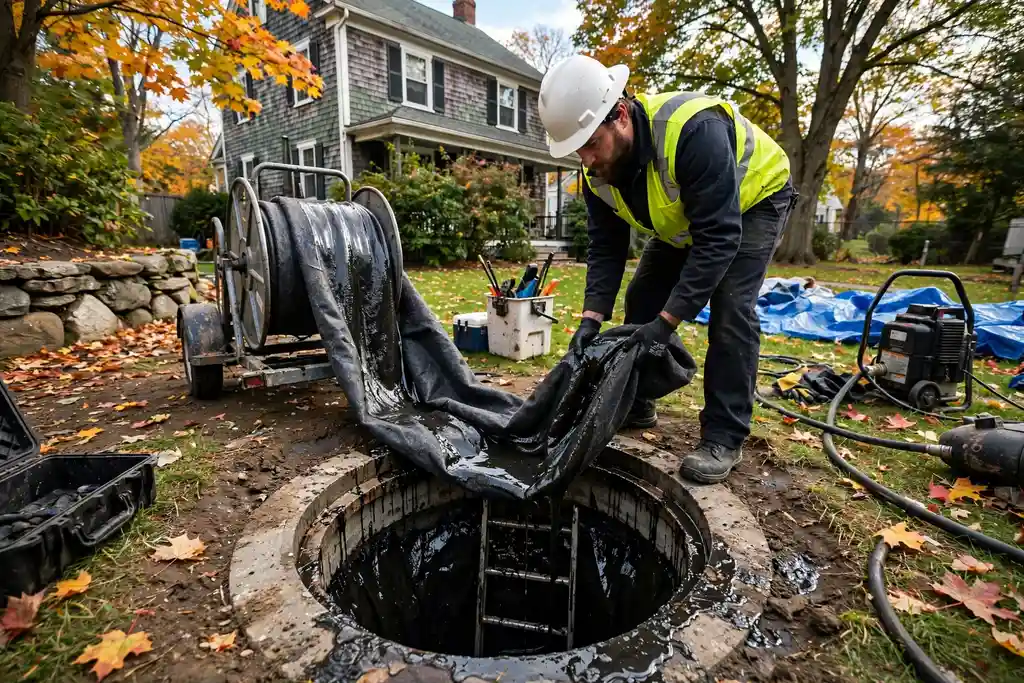
Cured-in-place lining rebuilds the lateral inside its existing path: a resin-saturated felt or fiberglass tube is inverted or winched into the old pipe and set with steam, hot water, or UV into a hard, seamless pipe-within-a-pipe. The hardened tube covers each cracked hub, offset joint, and root-packed section of the run. In Stoneham, where the Middlesex Fells geology puts bedrock or bouldery till within a few feet of the surface — especially on the southern half of town near the Fells — staying inside the existing pipe is what keeps a lateral renewal from becoming a rock-excavation project.
The town's laterals are past typical service life as a rule. Early-1900s and late-1800s homes — the dominant stock, with most homes built pre-1940 — typically carry clay tile or cast-iron laterals now 80 to 120 years old; post-war builds may run clay tile or Orangeburg. A century of freeze-thaw, root intrusion from the town's heavy tree cover, and joint failure is the baseline. Cracked, offset, root-packed clay with walls still round and continuous is the textbook candidate; Orangeburg runs get an individual read, since deformed-but-continuous fiber can line while delaminated fiber cannot.
The boundary stays structural. Collapsed runs, fully separated joints with missing pipe, and deep bellies holding standing water do not line — those segments get pipe bursting or a short open repair at that spot. Pockets of poor drainage near Spot Pond Brook and the Fells' wetland margins mean infiltration is checked on the wetter lots before the liner goes in, with active joints sealed first. The camera survey — read with the rock and the water in mind — writes the installation plan.
Fells Rock, Old Pipe, and the Trenchless Default in Stoneham
Stoneham's dominant variable is rock. The town sits on glacial till over bedrock with rocky outcrops characteristic of the Middlesex Fells — the Fells' southern half occupies much of Stoneham — and excavation for full lateral replacement can hit bedrock or bouldery till within a few feet, especially on the southern half of town. That geology makes trenchless pipe bursting or cured-in-place lining the practical default and open-cut the expensive exception. The camera survey maps where the pipe meets rock; the liner then works inside the pipe that is already threaded through it.
The housing stock is the other half of the case. Most homes were built pre-1940, with many single-family homes from the early 1900s and late-1800s Victorians and colonial-inspired builds in neighborhoods like Lindenwood, Bear Hill, and Colonial Park. Their laterals — clay tile or cast iron, 80 to 120 years old — are past typical service life, with tree-root intrusion from the town's heavy canopy as the signature failure. Full basements are typical in the early-1900s stock (poured concrete or block), with fieldstone or rubble under the late-1800s Victorians; the liner enters through small access points and leaves those foundations alone.
Water plays a supporting role. Drainage is generally good on the town's higher ground, but pockets of poor drainage occur near Spot Pond Brook and the Fells' wetland margins, and spring melt from the Fells' rocky hillsides can overload low-lying laterals and foundation drains. On those lots the infiltration check is standard practice before the liner goes in. Frozen ground each winter shifts soil and stresses old clay laterals — and the jointless cured tube is the answer to exactly that failure mode, since there are no joints left for frost heave to work on.
The Lining Process on a Stoneham Property
Camera survey with rock and water mapping
The camera maps the full lateral from house to main — joints, offsets, roots, bellies — noting where the pipe encounters bedrock or bouldery till. On lots near Spot Pond Brook or the Fells' wetland margins, the technician also assesses infiltration for the pockets of poor drainage.
Cleaning, descaling, and sealing
Roots are cut mechanically — the town's heavy tree cover makes this a substantial pass — and iron sections descaled and hydrojetted until the interior is round and clean. Active infiltration joints are sealed first; the crew confirms the host is continuous enough to line.
Liner placement and cure
The liner is sized to the surveyed run, saturated with resin, and winched into place through the access point. Cure conditions are verified against live site readings, with the rock-encounter and water observations from the survey folded into the plan.
Final camera pass and video record
The camera makes one last pass through the cured liner, confirming a jointless interior, sealed joints, and clean transitions at both ends. The video documenting the lined run from house to main goes home with the homeowner.