
What a Camera Inspection Sees in Beverly's Century-Old Sewer Lines
Roughly 43% of Beverly homes were built before 1939, and that age shows up underground: a camera inspection here commonly documents vitrified clay laterals with root intrusion at offset joints, and century-old cast iron narrowed by scale or sagging into bellies that hold water. Because so much of the housing stock is pre-war, inspection is treated as the mandatory first step — lining or replacement can't be designed without knowing the pipe's material, condition, and depth.
Near the harbor and along marsh-adjacent streets, the water table runs high, so a camera pass in these neighborhoods doubles as an infiltration survey: groundwater inflow through open joints can defeat a trenchless liner unless those joints are sealed first, and the footage shows exactly where inflow enters. Oceanfront properties add saltwater-influenced soils, so the inspection also assesses exterior corrosion on older cast iron.
Access is practical here. Downtown around Cabot Street runs on narrow streets that limit equipment staging, so inspections typically route through an existing cleanout or the basement stack — full basements are standard in Beverly's pre-1960 homes, though the earliest-built sit on fieldstone or rubble walls that need a careful touch. Many downtown Victorians and colonials hold finished or converted basement units, so interior access is planned around occupied space.
The camera also sorts Beverly's newer layers from its older ones. Post-1980 construction around the Endicott College area and newer infill typically runs PVC, while the oceanfront Victorians near Lynch Park and the antique 17th-century homes carry the heaviest retrofit histories — the footage tells a 1980s PVC line from a century-old clay run in seconds, which keeps repair quotes honest. On oceanfront roads with coastal flood exposure, the inspection also notes shallow burial depth and saltwater-influenced corrosion at the same time, since both shorten a pipe's remaining life. Where downtown homes were divided into apartments or condos, fixture counts run higher than the original lateral was sized for, so the camera pass doubles as a capacity check alongside the condition survey.
Why the Camera Goes In Before Any Repair Decision
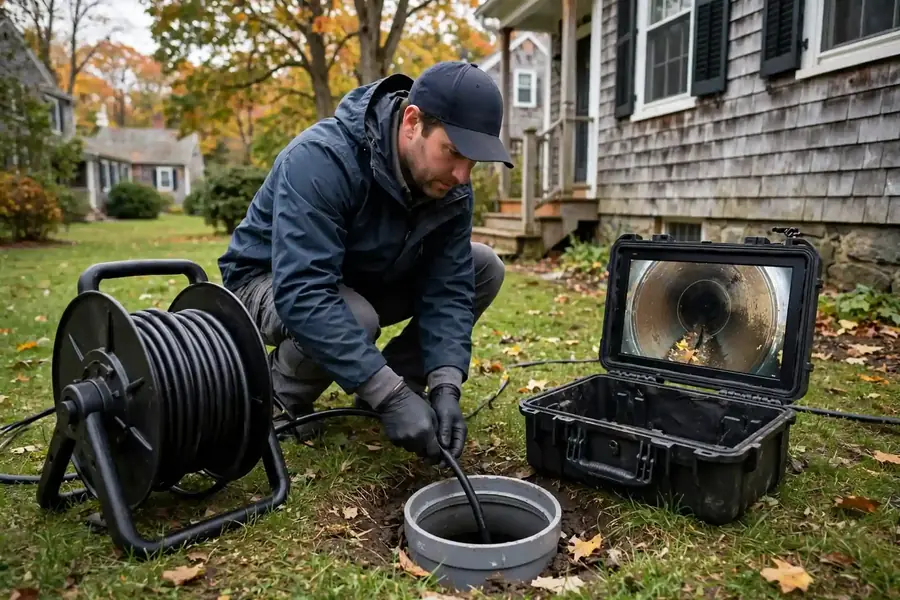
A sewer camera inspection is a video survey of the inside of the pipe — a small, self-leveling camera head pushed on a flexible cable from the cleanout to the street connection, recording everything it passes with a running distance count. In Beverly, where so many laterals date to the pre-war era, that survey is what separates a guess from a plan: it identifies whether the line is vitrified clay, cast iron, or a newer material, and whether the trouble comes from roots, offset joints, scale buildup, or a sagging belly that holds water.
The footage does more than find blockages. A transmitter in the camera head lets the technician mark the line's path and each trouble spot from above ground, mapping the pipe's depth and location. On a century-old Beverly lateral, that map shows exactly which joints have shifted or opened, where roots enter, and whether groundwater is flowing in through cracks — the details that decide whether a line is a candidate for trenchless lining, a targeted spot repair, or full replacement.
Timing matters for the same reason. Near the harbor, where the water table runs high, groundwater leaking in through open joints can defeat a trenchless liner if those joints aren't sealed first — so inspections here often double as infiltration surveys, ideally run when the water table is up. The visit itself is straightforward: access through an existing cleanout or the basement stack, usually an hour or two of camera work, and footage reviewed with the homeowner before any repair is designed.
What the Camera Typically Finds Under Beverly's Pre-War Homes
With 43% of Beverly's homes built before 1939 and a median home age around 65 years, the camera's most common assignment is documenting vitrified clay laterals that have endured a century of freeze-thaw movement. The signature findings are root intrusion at the joints — every three-foot clay section is a potential entry point — and offset or separated joints where frost heave has shifted the pipe. Inside the house, century-old cast iron typically shows up narrowed by scale or sagging into bellies, and the camera reads both conditions on the same pass.
Location changes the findings. Near the harbor and along marsh-adjacent streets, the water table sits high, so the camera routinely documents active infiltration — groundwater streaming in through open joints during wet conditions — which becomes the controlling factor in the repair plan. On oceanfront roads with saltwater-influenced soils, the footage also records exterior corrosion on older cast iron, sometimes as flaking or thinning that the camera catches when the head turns. Coastal flood exposure adds shallow burial depth to the watch list, since flood-prone shallow lines live shorter lives.
The town's layered housing adds one more camera task: sorting pipe generations. Post-1980 construction around the Endicott College area and newer infill typically runs PVC with a simple inspection profile, while the oceanfront Victorians near Lynch Park and the antique 17th-century homes carry the heaviest retrofit histories — the footage tells a 1980s PVC line from a century-old clay run in seconds. Where downtown Victorians and colonials were divided into apartments or condos, the camera pass also functions as a capacity check, since fixture counts now exceed what the original lateral was sized for.
How a Camera Inspection Visit Runs in Beverly
Cleanout access, no digging
The technician starts at an existing cleanout or the basement stack — full basements are standard in Beverly's pre-1960 homes — so nothing is excavated to get the camera into the line. Fieldstone or rubble walls in the earliest-built homes get a careful approach, and finished basement units are worked around without disruption.
Full run video survey
The camera travels the entire lateral to the street connection, logging material, joint condition, root entries, offsets, bellies, and any active infiltration. A transmitter in the head marks the pipe's depth and the location of each defect from above ground.
Infiltration and corrosion check
Near the harbor and on oceanfront streets, the pass doubles as an infiltration survey: the footage records where groundwater enters, and older cast iron is checked for saltwater-influenced exterior corrosion that interior video can miss.
Footage review and repair plan
You watch the key sections of the recording with the technician, who explains what each finding means for the repair — lining candidate, spot repair, or replacement — so the plan is built on the video record, not on assumptions about the home's age.