
Century-Old Clay Under Triple-Deckers: Camera Work in Lynn
Lynn's housing runs old — median build year 1925 citywide, 1910 in the Lynn English neighborhood, 1924 downtown — and the dense two- and three-family houses from the shoe-factory boom still run original clay-tile laterals. A century of freeze-thaw movement has shifted those joints, and the camera documents the result joint by joint: offsets, cracks, and root intrusion in lines that have been in the ground since the early 1900s.
Digging is tight here: small lots, narrow side yards, and shared driveways frequently make open-trench replacement impractical, so the camera's real value is planning a repair that fits the footprint — lining or point repair routed from a cleanout, with footage mapping exactly which sections are failing.
Coastal pockets along the Lynn Shore Drive corridor add high seasonal water tables and salt-influenced soils that corrode cast-iron house connections; trenches saturate fast during storms. Shallow cover over old lines near the shore also leaves laterals vulnerable to surface traffic and landscaping equipment — the camera checks for crushed or deformed sections, not just roots.
The Diamond District's larger shore homes and the newer townhome construction near Birch Brook break the pattern — bigger lots, sometimes newer pipe — so the camera first establishes what generation of lateral is in the ground. Around Central Square and the Market Street commercial core, laterals run under pavement and shared commercial frontage, and the inspection scopes trenchless paths that keep businesses open. In the dense triple-decker blocks, the camera's footage count also settles a practical question: where the lateral crosses a shared driveway or a neighbor's side yard, the video record documents the exact alignment so repair plans respect property lines that were drawn a century ago.
Planning a Repair That Fits the Footprint
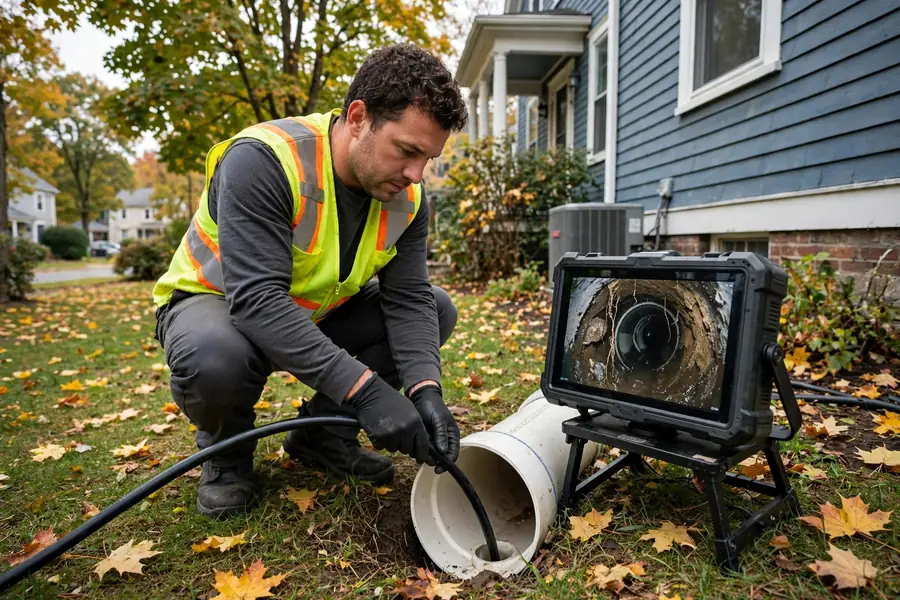
In Lynn, a camera inspection is an access-planning exercise as much as a diagnosis. The setup is the everyday one — a leveling camera head driven down the lateral on a push cable from the cleanout, footage tallied as it goes — but the survey answers a Lynn-specific question first: what can actually be repaired here, given the lot? Small lots, narrow side yards, and shared driveways frequently make open-trench replacement impractical, so the footage is what proves a lining or point-repair path routed from a cleanout instead.
The camera maps the line joint by joint, and that granularity is what keeps the repair honest. Lynn's dense two- and three-family houses from the shoe-factory boom still run original clay-tile laterals, and a century of freeze-thaw movement has shifted those joints. The footage distinguishes offsets from cracks, root masses from collapsed sections — the difference between a lining candidate and a line that needs bursting. Where the lateral crosses a shared driveway or a neighbor's side yard, the video record also documents the exact alignment, so repair plans respect property lines drawn a century ago.
The transmitter in the camera head adds the surface dimension: the technician marks the pipe's depth and path from above ground, flagging shallow cover near the shore and crushed or deformed sections where surface traffic or landscaping equipment has stressed the line. In the Diamond District's larger lots and the newer townhome construction near Birch Brook, the same pass first establishes which generation of pipe is in the ground — the inspection scopes the repair to the pipe that exists, not the pipe the era suggests.
Century-Old Clay Under Triple-Deckers: Lynn's Camera Findings
Lynn's housing runs old — median build year 1925 citywide, 1910 in the Lynn English neighborhood, 1924 downtown — and the camera's findings follow the era. The dense two- and three-family houses from the 1850–1920 shoe-factory boom, when Lynn grew as the shoe center of the country, still run original clay-tile laterals with cast-iron interior stacks. A century of freeze-thaw movement has worked those joints, and the footage documents the result joint by joint: offsets, cracks, and root intrusion in lines that have been in the ground since the early 1900s.
Density shapes every finding. Small lots and shared driveways mean laterals often run under pavement and shared commercial frontage — around Central Square and the Market Street core, the camera scopes trenchless paths that keep businesses open and neighbors undisturbed. In the triple-decker blocks, where one lateral may serve a building housing several households, the footage count settles the practical question of alignment: exactly where the line runs, at what depth, and which sections are failing, so the repair plan touches only the pipe.
The shore adds a second profile. Along the Lynn Shore Drive corridor, high seasonal water tables and salt-influenced soils corrode cast-iron house connections, and trenches saturate fast during storms — the camera documents infiltration and checks for crushed or deformed sections under shallow cover, not just roots. The Diamond District's larger shore homes and newer townhomes near Birch Brook break the century-old pattern with bigger lots and sometimes newer pipe, which is why the camera establishes the pipe generation first: the findings follow the lot, not the ZIP code.
How a Lynn Camera Inspection Runs
Cleanout access on tight lots
The camera goes in through an existing cleanout, so small lots, narrow side yards, and shared driveways stay untouched. No excavation is needed to start the survey — the whole inspection happens inside the pipe.
Joint-by-joint video mapping
The camera travels to the street main with a running distance count, logging clay-tile joints, root entries, offsets, cracks, and any collapsed sections. The footage distinguishes a lining candidate from a line that needs bursting.
Alignment and depth marking
The transmitter marks the lateral's path and depth from above ground — critical where the line crosses a shared driveway or runs under pavement near Central Square, so the repair plan respects century-old property lines.
Footprint-fit repair plan
You review the footage with the technician and get a plan scoped to the lot: lining or point repair routed from the cleanout where trenching is impractical, with the video record documenting exactly which sections are failing.