
Tidal Infiltration and the Lowlands System: Camera Work in Nahant
Nahant's municipal gravity sewers all feed one node — the Lowlands Pump Station — which pushes wastewater through the Lynnway force main to the Lynn treatment plant. The town has funded a roughly 7.9-million-dollar upgrade plus gravity-sewer rehabilitation aimed squarely at inflow and infiltration: spot repairs, full liners, joint sealing and grouting, root treatment, and watertight manhole covers in low-lying areas. Private laterals connect into a system under active rehabilitation, so a camera inspection is the record that shows whether a home's lateral contributes to the town's infiltration problem — DPW flags problem connections quickly here.
The peninsula's rocky geology puts ledge at shallow depth, so the camera maps pipe depth and rock encounters before any excavation is planned. In the Lowlands and on waterfront properties, the inspection documents tidal-influenced infiltration — active inflow through joints that rises and falls with the tide — which is a different repair conversation than a simple root blockage.
During major storms, wave overtopping at Black Rock and Short Beach floods interior Lowlands areas, and a post-storm camera pass checks for surge-driven sediment and joint displacement. The Causeway is the town's single land route, which keeps equipment access straightforward even as staging space stays tight.
Nahant's historic core — the 1870–1910 boom's grand late-1800s Victorians, Shingle-style and Colonial Revival summer cottages along Ocean Street — runs pre-1920 clay laterals and cast-iron stacks, and the camera commonly finds a century of root intrusion and joint displacement in lines laid for summer homes, not year-round use. Lowlands-area and waterfront homes frequently sit low with shallow foundations vulnerable to groundwater intrusion, so the inspection checks the full lateral for tidal inflow, not just the street connection. Mid- and late-20th-century infill typically runs cast iron transitioning to PVC — a simpler camera pass that confirms material and rules out the infiltration problems dominating the older stock.
Your Lateral's Record in a Town Fighting Infiltration
In Nahant, a camera inspection is a personal record inside a public project. The town's municipal gravity sewers all feed one node — the Lowlands Pump Station — which pushes wastewater through the Lynnway force main to the Lynn treatment plant, and Nahant has funded a roughly 7.9-million-dollar upgrade plus gravity-sewer rehabilitation aimed squarely at inflow and infiltration: spot repairs, full liners, joint sealing and grouting, root treatment, watertight manhole covers. A private lateral connects into a system under active rehabilitation, so the camera survey shows whether a home's line contributes to the infiltration the town is spending millions to eliminate.
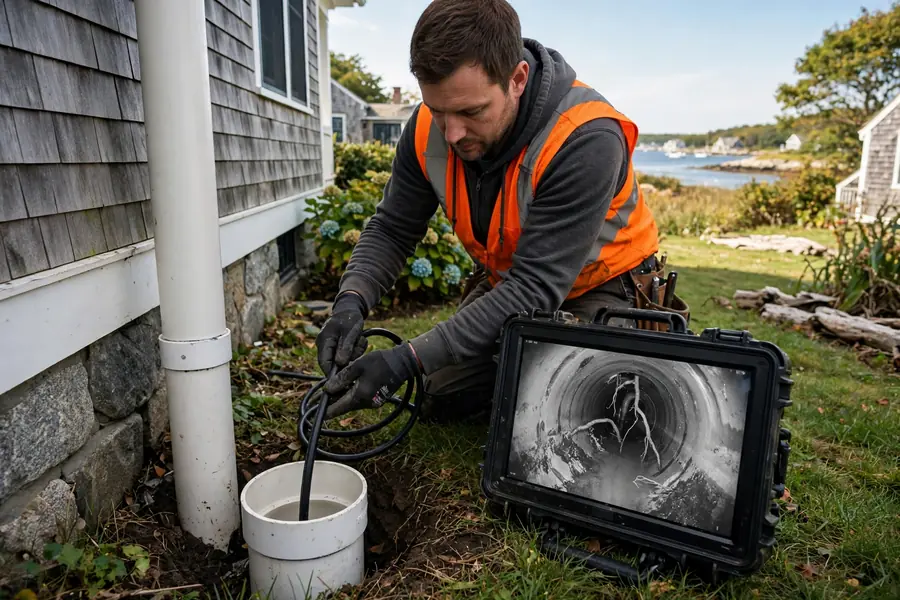
The survey runs on the usual push-camera hardware — leveling head, flexible cable, footage counter, surface transmitter — but the read is tidal. In the Lowlands and on waterfront properties, the inspection documents tidal-influenced infiltration: active inflow through joints that rises and falls with the tide, a different repair conversation than a simple root blockage. The peninsula's rocky geology puts ledge at shallow depth, so the camera also maps pipe depth and rock encounters before any excavation is planned — depth data that keeps the next step honest about rock.
Storm history gets its own pass. During major storms, wave overtopping at Black Rock and Short Beach floods interior Lowlands areas, and a post-storm camera survey checks for surge-driven sediment and joint displacement — damage the storm leaves behind inside the pipe. The Causeway is the town's single land route, which keeps equipment access straightforward even as staging space stays tight, so scheduling the survey is the easy part.
Tide, Rock, and Victorian Clay: Nahant on Camera
The town's single-node system shapes every Nahant finding. All gravity sewers feed the Lowlands Pump Station, and the town's rehabilitation program — targeting high-priority inflow and infiltration with liners, joint sealing, grouting, and root treatment — sets the standard the private side is measured against. The camera survey records whether a home's lateral adds to that infiltration load, and the DPW flags problem connections quickly here. Footage showing tidal inflow at the joints is the record that starts the repair conversation on the homeowner's side of the connection.
Geology writes the second set of findings. The peninsula's rocky coasts put ledge at shallow depth, so the camera maps pipe depth and rock encounters along every run — the depth log that proves whether a repair can trench or must go trenchless. In the Lowlands and on waterfront properties, the inspection records tidal-influenced infiltration directly: inflow that tracks the tide cycle, visible on camera as water entering through joints in rhythm with the harbor. Lowlands-area and waterfront homes frequently sit low with shallow foundations vulnerable to groundwater intrusion, so the survey checks the full lateral for tidal inflow, not just the street connection.
The historic core adds the age layer. The 1870–1910 boom's grand late-1800s Victorians, Shingle-style and Colonial Revival summer cottages along Ocean Street run pre-1920 clay laterals and cast-iron stacks — lines laid for summer homes, not year-round use — and the camera commonly finds a century of root intrusion and joint displacement. Mid- and late-20th-century infill typically runs cast iron transitioning to PVC, a simpler pass that confirms material and rules out the infiltration problems dominating the older stock. Tide, rock, Victorian clay: the camera reads the peninsula's whole story.
How a Nahant Camera Survey Runs
Cleanout access, tight staging
The camera enters through an existing cleanout — no excavation, no heavy staging on the peninsula's tight streets. Access via the Causeway keeps scheduling straightforward.
Tidal infiltration watch
The survey records roots, offsets, and joint condition along the full run, with special attention to tidal-influenced inflow: water entering through joints in rhythm with the tide, the signature Nahant finding.
Depth and ledge mapping
The transmitter marks pipe depth and rock encounters from above ground — the depth log that keeps any future repair honest about shallow ledge before excavation is ever discussed.
Infiltration-contribution report
You review the footage with the technician and get a clear read: does your lateral contribute to the town's infiltration problem, and what fixes it — joint sealing, lining, or root treatment — matched to what the camera observed.