
Sewer Line Installation on Beverly's Glacial Till — and Its Harbor Edge
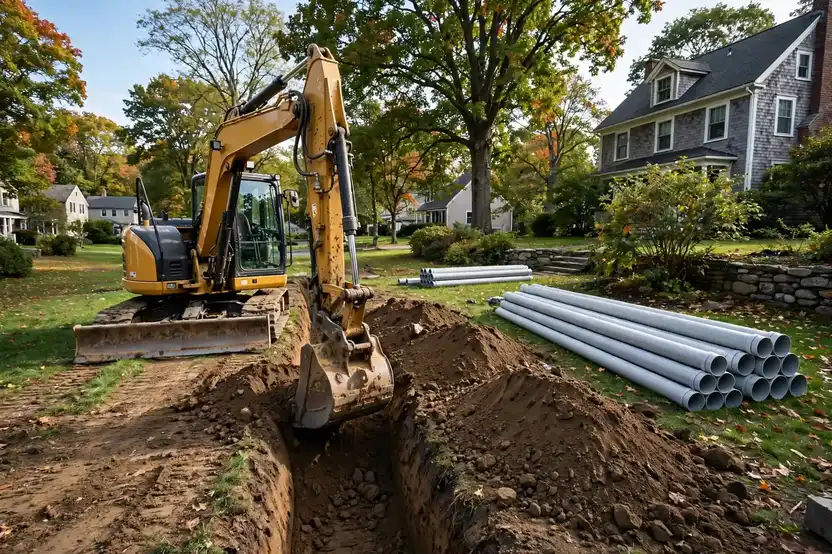
New sewer line installation in Beverly is shaped by a soil map that changes within a few blocks. Most upland lots sit on Essex-series gravelly sandy loam, easy digging at first, but dense glacial till typically appears 20 to 30 inches below grade. The trench for a new line has to be cut through that hardpan so the pipe's pitch stays constant instead of riding over it and creating low spots where solids settle. Near the harbor and the tidal inlets, the soil flips entirely to very poorly drained tidal-marsh muck with a high water table. There, installation becomes a dewatering job before it becomes a trenching job: a saturated trench cannot hold pitch, and loose muck migrates into bedding unless the trench walls are controlled.
Freeze-thaw heave is the force that destroys rigid joints over decades, so new lines here get stone bedding beneath the full run rather than native backfill, with pitch checked continuously along the run instead of only at the two ends. On oceanfront and marsh-adjacent streets, the saltwater-influenced soils argue for corrosion-resistant pipe in the lateral, because the same conditions that attack older metal lines will be waiting for the new one. The tap connection to the municipal main gets sealed watertight at the main itself, because where the water table runs high, an unsealed tap gives groundwater a direct path into the town system.
Logistics depend on which Beverly is being built in. New construction away from the water usually allows straightforward open-trench work with room to stage equipment. Downtown around Cabot Street and the older neighborhoods, where 43 percent of the housing stock predates 1939 and colonials have been divided into apartments and condos, new installations are typically additions, ADUs, or teardowns on tight infill lots. Narrow street frontage limits equipment size, so these jobs favor compact excavation and short, direct trench alignments from the building exit to the main.
How Sewer Line Installation Works in Beverly
Every installation starts with a site walk and a probe of the trench line. On Beverly's upland lots, that means confirming where the dense till hardpan sits, usually 20 to 30 inches down, so the excavation plan budgets for cutting through it rather than discovering it mid-dig. The trench is dug to a uniform depth below the pipe's design grade, wide enough to work in but no wider, and the bottom is cleared of stones that could press into the pipe. Near the harbor and the tidal inlets, the same walk looks for something else: standing water and muck, which means the dewatering setup is arranged before the excavator arrives, not after the trench fills.
Pipe goes in on stone bedding, not on native soil. The bedding is screeded to grade, the pipe is laid bell-uphill, and the pitch is checked with a level at every joint, not just at the ends, because a single flat joint in the middle of the run becomes a settling point for solids. In Beverly's freeze-thaw ground, flexible watertight gaskets are used at every joint so seasonal heave moves the soil without opening the pipe. Backfill goes in lifts and is compacted as it rises, which keeps the trench from settling into a sunken stripe across the yard a year later.
The final connection is the tap into the municipal main, and in Beverly it is sealed watertight at the main, especially on harbor-side streets where the water table runs high. On oceanfront and marsh-adjacent streets, the pipe and fittings are selected for saltwater-influenced soils so corrosion does not shorten the new line's life. Before the trench is closed, the run is camera-checked to confirm the pitch on the plan matches the pitch in the ground.
Beverly Ground Conditions That Shape an Installation
Beverly sits on Essex County glacial terrain, and the soil profile is the fact that matters most for digging: Essex-series gravelly sandy loam at the surface, well drained and easy to cut, over dense subglacial till 20 to 30 inches down. That hardpan is the layer every trench has to get through to hold a true pitch. In the low areas near the harbor and the tidal inlets, the profile changes completely to very poorly drained tidal-marsh muck, with the water table running high and coastal flood exposure on the oceanfront roads. An installation plan that works on the uplands will not work at the water's edge, and the two are sometimes only blocks apart.
The housing stock adds the second layer. Beverly is one of the older stocks on the North Shore: 43 percent of units were built before 1939, with downtown colonials and Capes, many divided into apartments or condos, plus oceanfront Victorians and 17th-century antique homes. Newer construction exists too, and installations split accordingly: open-trench work with room to stage on new-construction lots away from the water, versus additions, ADUs, and teardowns on tight infill lots downtown, where narrow frontage around streets like Cabot Street limits equipment size.
Weather is the long-term load on every new line. Nor'easters bring heavy rain, storm surge, and winter freeze; frost depth drives the freeze-thaw heaving that shifts soil around laterals, and spring melt plus rain can surcharge low-lying lines. Coastal sections see saltwater-influenced corrosion conditions. A new installation in Beverly is therefore built for movement and water: stone bedding that resists heave, watertight joints, sealed taps, and corrosion-conscious materials on the harbor side.
Our Installation Process in Beverly
Site walk and soil probe
We walk the trench line, probe for the dense till layer, and check for high water near the harbor, then set the alignment, depth, and equipment plan before anything is dug.
Trenching and dewatering
The trench is cut through the hardpan to a uniform grade, with dewatering running on harbor-side lots where muck and groundwater would otherwise fill the excavation.
Bedding, pipe, and pitch
Stone bedding is screeded to grade, pipe is laid with the pitch checked at every joint, and flexible watertight gaskets handle freeze-thaw movement.
Tap connection and restoration
The tap into the municipal main is sealed watertight, the run is camera-verified, backfill is compacted in lifts, and the surface is restored.