
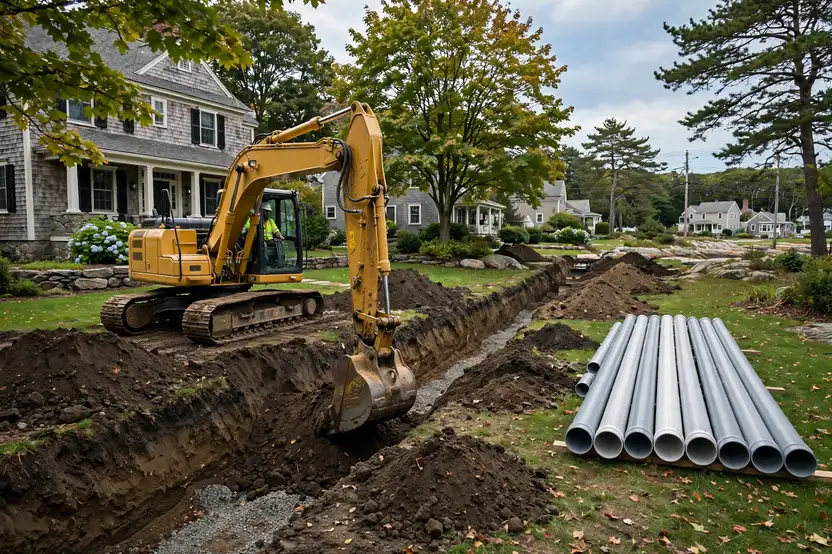
Gloucester Installations Are Decided by Ledge: Planning Around Granite Before Digging
In Gloucester, the first question about a new sewer line is not where it goes, it is whether rock is in the way. The town sits on thin, rocky glacial soils: the USDA's Annisquam series, typed in Gloucester itself, is fine sandy loam over dense till just 20 to 30 inches down, laced with 5 to 25 percent cobbles and stones, and Cape Ann granite ledge outcrops are common. An open trench for a new installation can hit rock within a few feet of grade, which is why the alignment is probed before any machine is scheduled. When ledge is confirmed along the route, the plan changes: either the alignment shifts to find a soil window, the rock is cut, which is slow and expensive, or the job moves to a trenchless method that bores through instead of digging. Stating this plainly in the estimate is part of the job. Rock is the difference between a one-day trench and a week of it.
The town's older housing adds its own complexity. Gloucester's 400 years of building left First Period houses, Georgian and Federal seaport buildings, sea-captain-era Greek Revivals, and 1920s estates, and any new installation tied to those properties meets shallow stone or rubble cellars, partial basements, and retrofitted plumbing whose geometry was never drawn on a plan. Near the Inner Harbor, the water table runs high and storm surge can back-flood low laterals, so new lines there get watertight joints along the full run and backflow protection at the municipal tap. That protection belongs in the original installation, not as a later retrofit. Exposed cast-iron components face salt spray and wind-driven rain, so modern pipe materials are chosen with that corrosion load in mind.
Equipment staging is a genuine planning task here. The steep, narrow streets of the East Gloucester hills and Rocky Neck do not take full-size excavators and dump trucks easily, so compact machinery and tight staging plans are standard. Where a new line serves a seasonal cottage being converted to year-round use, capacity and frost protection both get reviewed: a line that worked for summer use gets deeper cover and careful pitch when it becomes a full-time sewer. And on slopes, where drainage is fast but the pipe has to hold a steady grade across falling ground, the trench is benched and the bedding compacted in lifts so the pipe never bridges across a soft spot.
Putting a New Sewer Line In on Cape Ann Rock
The defining step of a Gloucester installation happens before excavation: probing the alignment for ledge. Test holes or a probe rod along the planned trench line reveal where granite sits, and the route is adjusted to thread soil windows wherever the lot allows. Where the line must cross rock, the choice is made up front between cutting it and boring through it, because discovering ledge mid-trench is how budgets break. On the steep streets of the East Gloucester hills and Rocky Neck, compact equipment is specified from the start, since full-size machines cannot stage or maneuver there.
Where open trenching proceeds, the cut goes through the Annisquam profile: sandy loam, then dense till laced with cobbles and stones, then rock if the probe found it. The trench bottom is cleaned to solid bearing, stone bedding is placed and graded, and the pipe is laid with its pitch verified continuously, because on a slope a small grade error runs downhill fast. Bedding is compacted in lifts and the trench is benched across falling ground so the pipe is supported along its whole length instead of bridging soft spots. Backfill is compacted as it rises to keep the hillside trench from settling.
Near the Inner Harbor and the coves, the installation adds the water defenses: watertight joints along the full run against high groundwater, and backflow protection at the municipal tap where storm surge can push water back up the lateral. Pipe materials are chosen for salt spray and wind-driven rain exposure. The finished run is camera-inspected to confirm grade, the tap is sealed watertight at the main, and the surface, often old street fabric on the historic streets, is restored to match.
Gloucester's Rock, Water, and Old Houses
Gloucester is the ledge town. The USDA's Annisquam soil series was typed here: fine sandy loam over dense till just 20 to 30 inches down, with 5 to 25 percent cobbles and stones, and granite ledge outcrops are common across Cape Ann. Many homes sit partially on exposed bedrock with shallow or partial basements, because the rock simply would not allow deeper digging when they were built. Drainage is fast on the slopes and poor in harbor-adjacent low pockets, and blasting or ledge encounters are a real excavation risk. Any installation estimate written without a rock plan is a guess.
The housing layers four centuries deep. First Period houses like the White-Ellery House from 1710 and the William Haskell House from around 1670, 18th-century Georgian and Federal seaport buildings, dense mid-to-late-19th-century Greek Revival and Italianate sea-captain houses around East Gloucester Square, 1920s grand summer estates like Hammond Castle and Beauport, plus 20th-century infill and seasonal cottages. The oldest homes have shallow stone and rubble cellars and retrofitted systems, typically mid-20th-century cast iron and clay, so the underground on any old lot is a retrofit story, not an original plan.
The coast is the third force. Nor'easters with storm surge, salt spray, freeze-thaw heave, spring melt, and harbor flooding that can surcharge low laterals all act on buried pipe, with coastal flood and surge exposure around the Inner Harbor and the coves. New lines near the water are built for it: watertight joints, sealed taps, backflow protection, and corrosion-conscious materials, because the ocean side of Gloucester never gives a new lateral an easy decade.
How Installation Runs in Gloucester
Ledge probing and routing
We probe the planned trench line for granite, adjust the route through soil windows where possible, and decide up front between rock cutting and boring.
Compact trenching
The trench is cut with compact equipment suited to steep narrow streets, through loam and cobbly till to solid bearing.
Bedding and graded pipe
Stone bedding is compacted in lifts with the trench benched on slopes, and pipe goes in with pitch verified continuously.
Water defenses and tap
Watertight joints, backflow protection at the tap, and a sealed municipal connection finish the run before restoration.