
Sewer Installation on Marblehead's Rocky Peninsula: Shallow Bedrock, High Water
Marblehead gives sewer installers demanding geology on a peninsula where new construction is genuinely rare. Only about 4 percent of homes were built after 2000, so most installation work means additions, ADUs, and rebuilds tied to older properties. The peninsula sits on hard Proterozoic rhyolite with frequent bedrock outcrops under thin glacial till, so laterals often lie in shallow rock trenches with poor cover. Before any trench is planned, the alignment is probed for ledge: where rock is shallow, the options are cutting it, shifting the alignment to find a soil window, or using a trenchless method for the crossing. Open-trench replacement that turns into rock excavation is the expensive surprise every Marblehead estimate is written to avoid.
Water is the second constraint. The town's own standards note areas where finished grade sits less than four feet above the water table, and near the harbor and the Neck that high groundwater is documented fact. A new line in those zones is installed with dewatering as part of the plan, stone bedding that will not migrate in saturated ground, and watertight joints along the full run, because groundwater that can infiltrate a cracked joint will also infiltrate a poorly sealed new one. The tap into the municipal system gets sealed at the main, and on low-lying streets near the water, backflow protection is installed with the new line rather than added after the first nor'easter-driven backup.
The third constraint is the town itself. Nearly 300 pre-Revolutionary homes survive in the Old Town's narrow, twisting streets, and the historic district's exterior-alteration approval requirement applies to surface disturbance, so the installation plan accounts for restoration, not just excavation: street surfaces, granite curbs, and old stonework go back the way they were found. With 46.5 percent of homes built before 1939, the building exit on a typical job is an old stone or brick foundation with minimal basement access, where the new line's connection is hand-set and the pitch from that exit point is surveyed before the trench is cut. Compact equipment is the default; the Old Town's tight lot lines simply do not take anything bigger.
Installing New Pipe on Shallow Rock and High Water
The Marblehead sequence starts with two investigations: rock and water. The alignment is probed for rhyolite ledge along the whole trench line, and the route is adjusted through soil windows wherever the lot allows, because cutting shallow rock for a full trench is the costliest version of this job. At the same time, the water table is assessed against the town's own standard, which flags areas where finished grade sits less than four feet above groundwater. Where both rock and water are present, the plan often pairs a shifted alignment with dewatering, keeping the trench as short and as shallow as the grade allows while still holding pitch.
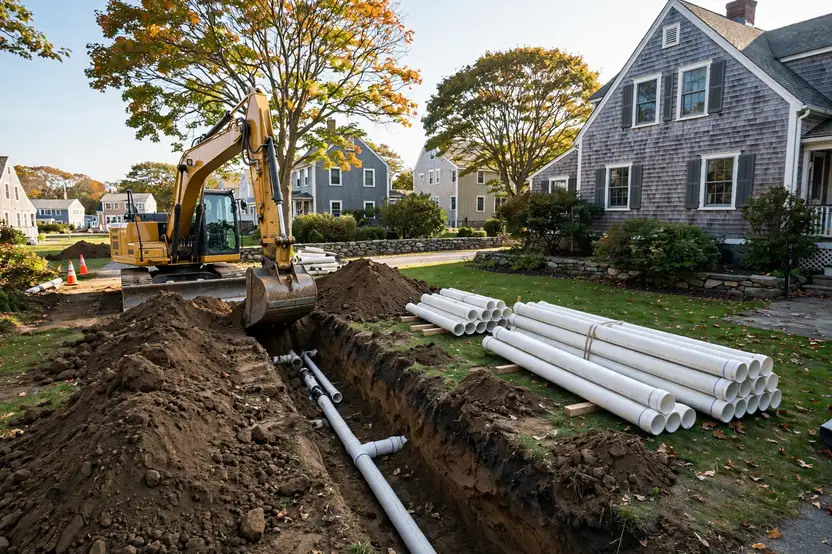
Trenching proceeds with compact equipment, since the Old Town's narrow winding streets and tight lot lines rule out full-size machines. The cut goes through thin till to whatever the probe found: more till, or rock that is cut or bypassed. Bedding stone goes down and is graded, then pipe is installed with its pitch checked nonstop, because a shallow rock trench leaves no room to hide a grade error. Every joint gets a watertight gasket, and in the documented high-water zones the bedding stone is sized to stay put in saturated ground while pumps hold the trench dry during laying.
The harbor-side finish is what separates a Marblehead installation from an inland one. Backflow protection goes in at the municipal tap on low-lying streets near the water, so the first nor'easter surge does not become the new line's first backup. The tap itself is sealed watertight at the main, and pipe materials are chosen with salt-air corrosion in mind. The building exit, usually old stone or brick with minimal basement access, is hand-set and sealed, the run is camera-verified, and the surface, street, granite curb, and old stonework, is restored to match the historic district's expectations.
Marblehead's Peninsula: Rock Underfoot, Water Alongside
Marblehead is a rocky peninsula, and the geology is unusually well documented. The town sits on hard Proterozoic rhyolite of the Lynn volcanic complex with blocky fracture and frequent bedrock outcrops, overlain by thin glacial till and swamp deposits. Shallow bedrock and thin soil mean limited soil cover over pipes, which is why laterals here so often lie in shallow rock trenches. The town's own design standards note areas where finished grade is less than four feet above the water table, requiring subdrains, so high water tables near the harbor are not a suspicion but a documented local condition.
The housing stock is old and largely single-family: the median year built is 1949, 46.5 percent of homes were built before 1939, another 32.7 percent from 1940 to 1969, and only 4.4 percent were built in 2000 or later. Nearly 300 homes survive from before the American Revolution, clustered in the narrow twisting streets of the Old Town historic district, and the 1970s-era historic-district safeguards mean sewer work in the Old Town often requires preservation approvals for any surface disturbance. Foundations in the Colonial-era stock are typically stone, rubble, or brick with shallow, often damp cellars and minimal access.
The ocean is the third given. Direct Atlantic exposure brings nor'easters with storm surge and harbor flooding, freeze-thaw cycles that work cracked joints, and salt spray that accelerates corrosion of exposed cast-iron components. Landmarks like the Marblehead Lighthouse at Chandler Hovey Park, Castle Rock, Abbot Hall, and Devereux Beach all sit on the same rhyolite and the same thin soils. A new line here is engineered for rock, water, and salt from the first sketch, because the peninsula offers no alternative ground.
The Marblehead Installation Process
Rock and water investigation
We probe the alignment for rhyolite ledge and assess the water table against the town's documented high-water areas before setting the route.
Compact trenching
The trench is cut with compact equipment through thin till, with rock cut or bypassed and dewatering running in high-water zones.
Bedding and watertight pipe
Stone bedding is graded, pipe is laid with pitch verified continuously, and every joint gets a watertight gasket.
Harbor-side tap and restore
Backflow protection and a sealed municipal tap finish the run, the line is camera-verified, and historic surfaces are restored.