
House to Tank, Not House to Street: Replacement on Septic in Middleton
Middleton is the outlier on this list, and any replacement quote has to start there: roughly 99% of homes are on septic, not public sewer. A sewer line replacement in Middleton almost always means replacing the building sewer — the line from the house to the septic tank. That changes the job's geography: shorter runs, shallower trenches, and a different failure map. In older farmhouses the classic break is the cast-iron-to-PVC transition at the foundation wall, where an original cast-iron building sewer meets a later septic retrofit; in the post-2000 subdivisions, the work skews toward root intrusion at tank inlets and grading problems around newer PVC.
The excavation conditions are wetland country. Middleton sits amid an extensive red maple swamp complex with peat bog and interconnected ponds, and the soils are poorly drained till with a seasonally high water table. Trenches here are shallow and saturated — dewatering is routine even for a short house-to-tank run — and any excavation near a wetland resource area has to respect buffer limits. The Middleton Board of Health governs this work directly: installer permits, inspections, and pressure testing of the sewer line are part of the sequence, so the replacement is scheduled around the inspection, not the other way around.
Near the house, the old farmhouses demand the same care as any historic foundation: stone and rubble walls, hand digging at the wall, and a new line bedded and pitched so it does not settle against old masonry. Because the run is short, full excavation is usually the economical choice here — there is no hundred-foot lawn to save with trenchless methods. A Middleton replacement done right ends with a pressure-tested, watertight line from foundation to tank, inspected and signed off, in ground that will try to float anything not bedded properly.
The Excavation Method for Sewer Replacement in Middleton
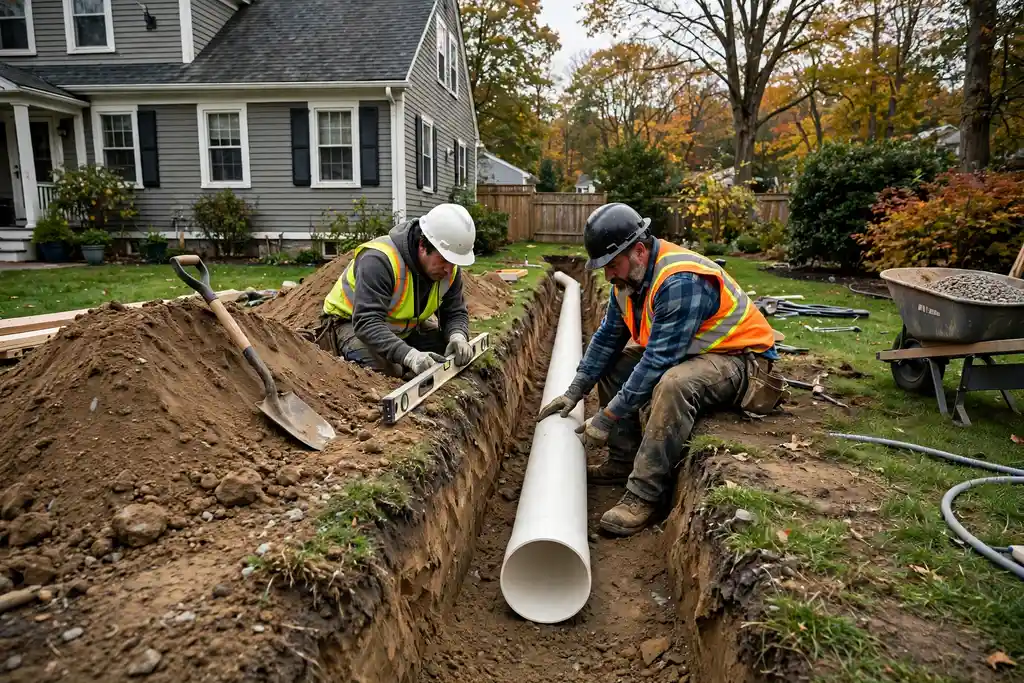
When the Middleton camera shows a cast-iron building sewer that has failed at the foundation wall where it transitions to PVC, or root intrusion at the septic tank inlet, excavation is the honest fix. The Middleton trench exposes the full run. In Middleton, every failed section of cast-iron building sewers in older homes and PVC or SDR-35 in post-1980 builds — house-to-septic-tank lines, not city laterals comes out. Across Middleton, intact runs may still go trenchless.
Middleton digging is different from every other town here: about ninety-nine percent of homes use septic systems, so the 'sewer line' is the building sewer from the house to the septic tank. The terrain is wetland-rich — a documented red maple swamp complex with peat bog and nine interconnected ponds — with seasonally high water tables and poorly drained till soils. Trenches run shallow and saturated, and any excavation near protected resource areas must respect wetland buffers, with Board of Health on-site-system rules shaping every job. The Middleton dig is planned around those conditions from day one.
In Middleton, going back: gasketed PVC with watertight joints on compacted stone. The Middleton crew verifies slope before backfill. Then large rural lawns, meadow edges, and the grades around septic tanks and leach fields are restored to match in Middleton.
Middleton Soil, Water, and Access: Why They Matter
Middleton mixes old-rural and new-suburban: fourteen percent of homes predate 1939, while twenty-four percent were built in 2000 or later, and about eighty-nine percent are owner-occupied single-family homes on large lots. The critical fact: roughly ninety-nine percent of homes have septic systems, not public sewer, so sewer-line work here overwhelmingly means the building sewer from house to tank. Older farmhouses pair stone-rubble foundations with original cast-iron building sewers and later septic retrofits; post-1980 subdivisions typically run PVC or SDR-35.
Wetland-rich terrain defines the dig: an extensive red maple swamp complex with peat bog and nine interconnected ponds, and standard NRCS mapping of hydrologic group, depth to bedrock, and depth to water table in town filings. Expect seasonally high water tables, poorly drained till soils, and wetland buffer constraints on any excavation. Nor'easters, freeze-thaw cycles, and spring melt round out the weather, and low-lying lots near wetlands can flood seasonally, surcharging shallow building sewers.
Because the town runs on septic, Middleton replacement jobs follow Board of Health on-site-system rules — installer permits, inspections, and pressure testing of sewer lines. The classic failure point is the cast-iron-to-PVC transition at the foundation wall in older farmhouses. In the post-2000 subdivisions the work skews toward inspection, root intrusion at tank inlets, and grading fixes around newer PVC lines rather than full replacement.
How a Middleton Sewer Replacement Proceeds
Video Survey and Utility Locating
In Middleton, video inspection comes first. The Middleton survey records the pipe's condition end to end in Middleton. Camera traces the building sewer from the house to the septic tank and logs the failure point in Middleton.
Opening and Shoring the Trench
The Middleton trench follows the marked line, worked in sections. In Middleton, shoring and pumps stand ready in Middleton. The trench is opened shallow with pumping, staying clear of wetland buffers and the leach field in Middleton.
Removing Old Pipe, Laying New
In Middleton, failed pipe is lifted and the new lateral is laid. In Middleton, every joint is sealed and the slope is checked in Middleton. The failed section is replaced — often the cast-iron-to-PVC transition at the foundation wall — and pressure-tested in Middleton.
Backfilling and Surface Restoration
Backfill goes in compacted lifts on the Middleton trench. In Middleton, the surface is restored to match in Middleton. Backfill is compacted in lifts and lawn grades around the tank are restored in Middleton.