
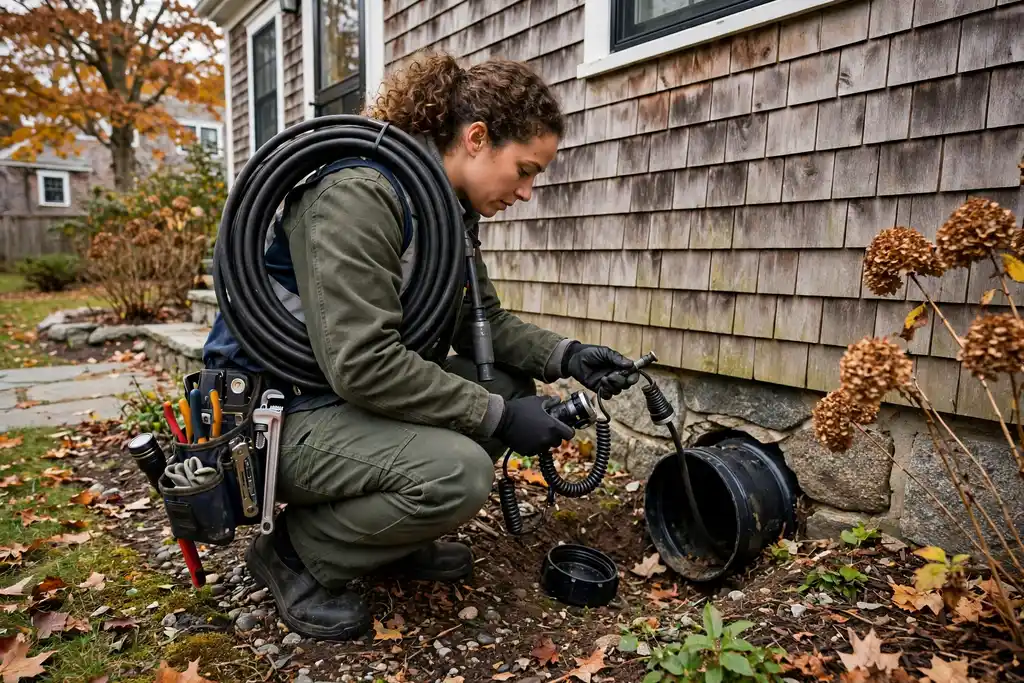
Marblehead Maintenance: Catch It Before the Rock Excavator Does
Marblehead has the hardest sewer geology on the North Shore, and that fact alone should shape every maintenance plan in town. The peninsula sits on hard rhyolite with frequent bedrock outcrops under thin glacial till — pipe frequently sits in thin rock trenches with minimal cover, so open-trench replacement regularly turns into rock excavation. Maintenance here is not optional upkeep; it is the strategy that keeps a lateral from ever needing a trench through ledge. The plan starts with a camera survey that maps exactly where the pipe runs shallow over rock, because those are the segments where failure is most expensive.
Nearly half the town's homes predate 1939, and almost 300 survive from before the American Revolution — but below the surface is usually the 20th-century clay-and-cast-iron generation, re-piped over the centuries. That means a maintenance plan cannot be built on the house's age; it needs a baseline camera survey first, establishing joint condition, root entries, and infiltration points as they exist today. Old Town's narrow winding streets and the historic district's approval requirements for surface disturbance make even small excavations slow and bureaucratic — scheduled, minimal-dig maintenance visits fit Marblehead's reality far better than emergency digs.
Water is the third maintenance driver. The town's own design standards note areas where finished grade sits less than four feet above the water table, and harbor and Neck properties face documented high groundwater plus nor'easter surge. Seasonal infiltration checks — spring, after the melt, and fall, before storm season — should be in every waterfront plan, along with salt-air corrosion review of exposed cast-iron components. Backup prevention matters as much as pipe condition here, so maintenance visits should include backwater-valve testing. In Marblehead, the plan is: inspect on schedule, treat roots before they spread, seal joints before they leak, and keep the rock excavator out of the picture entirely.
Rock-Avoidance Maintenance Plans for Marblehead
A Marblehead plan is designed around the ledge. The opening camera survey pinpoints where the lateral runs shallow over rhyolite bedrock versus deeper soil, and the shallow-over-rock segments — where a failure would mean rock excavation — receive the tightest monitoring interval in the program. Every subsequent service is chosen to extend trenchless-serviceable life: camera, cleaning, root treatment, and sealing-compatible monitoring that keeps the pipe viable without ever opening the ground.
The seasonal cycle serves the town's two exposures. Spring brings infiltration checks for harbor and Neck properties, where the town's own standards document grade less than four feet above the water table and nor'easter surge adds pressure from the sea side; the survey looks for groundwater entering cracked joints and for infiltration-driven backup risk. Fall brings root treatment across the full run — below the surface is usually the 20th-century clay-and-cast-iron generation, and its joints take the same root pressure as anywhere — with camera verification of coverage.
Waterfront properties get two scheduled add-ons: salt-air corrosion review of exposed cast-iron components, and backwater-valve testing, because backup prevention matters as much as pipe condition where surge meets a high water table. Old Town's narrow winding streets and the historic district's approval requirements for surface disturbance shape the logistics: every visit is a small, planned, minimal-dig service — never a production that needs staging room the streets do not have. In Marblehead, the plan keeps the rock excavator out of the picture entirely.
Bedrock, Old Houses, and Harbor Water: Marblehead's Triple Constraint
Marblehead has the hardest sewer geology on the North Shore. The peninsula sits on hard Proterozoic rhyolite of the Lynn volcanic complex with frequent bedrock outcrops, overlain by thin glacial till — pipe frequently sits in thin rock trenches with minimal cover. Open-trench replacement here regularly turns into rock excavation, which is why the maintenance plan treats every offset joint as something to catch early: the economics of this town punish deferred maintenance more than anywhere else on the list.
The houses are old but the pipe is newer than it looks. Nearly half the town's homes predate 1939 and almost 300 survive from before the American Revolution — among the largest concentrations of 17th- and 18th-century homes in the country — yet below the surface is usually the 20th-century clay-and-cast-iron generation, re-piped over the centuries. A plan cannot be priced from the house's age; the baseline camera survey establishes joint condition, root entries, and infiltration points as they exist today. Many Old Town homes have partial or minimal basement access, which the plan's interior scope accounts for in advance.
The harbor completes the constraint set. Direct Atlantic exposure — nor'easters driving storm surge and harbor flooding, salt spray accelerating corrosion of exposed cast iron — combines with documented high water tables near the harbor and Neck to make infiltration and backup the twin water risks. The historic district's exterior-alteration approval requirement makes even small surface work slow and bureaucratic. In Marblehead, bedrock sets the cost of failure, old houses set the inspection baseline, and the harbor sets the water schedule — the plan answers all three.
The Marblehead Minimal-Dig Service Cycle
Ledge-mapping baseline survey
We camera the lateral and log precisely where the line runs shallow over rhyolite, assigning the rock-risk segments the tightest monitoring interval.
Spring infiltration check
For harbor and Neck properties, we survey for groundwater entering joints and assess infiltration-driven backup risk after the melt and storm season.
Fall root treatment
Treatment covers the full run of 20th-century clay ahead of winter, with camera confirmation — roots do not care how old the house is.
Corrosion review and valve testing
Waterfront visits include salt-air corrosion review of exposed cast iron and scheduled backwater-valve testing.