
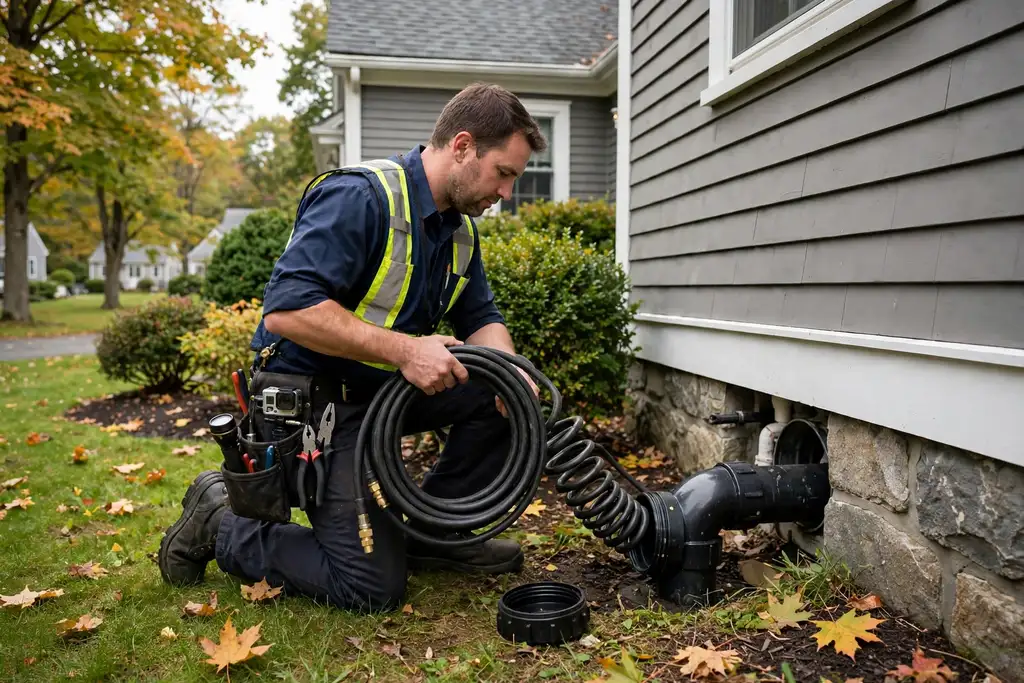
Middleton Maintenance Means the Building Sewer and the Septic System
Middleton changes the definition of sewer maintenance, because about 99% of the town's homes run on septic systems rather than public sewer. There is no municipal lateral to maintain here — the "sewer line" is the building sewer running from the house to the septic tank, plus the tank inlet and the lines around the leach field. A maintenance plan in Middleton starts with that understanding: scheduled camera inspection of the house-to-tank run, cleaning on a cycle matched to the household, and specific attention to root intrusion at the tank inlet, where roots find the moisture and nutrients they want most.
The town's wetland-rich terrain sets the schedule's rhythm. Seasonally high water tables and poorly drained till soils mean spring melt can saturate shallow building sewers and surcharge leach fields, so a spring inspection — timed after the melt — is the year's most important visit: it checks for infiltration into the building sewer, root pressure at the tank inlet, and grading or drainage problems around newer PVC lines. In the post-2000 subdivisions, where lines are young PVC, maintenance skews toward exactly these drainage and root issues rather than age-related failure.
The older farmhouses need their own plan. Stone and rubble foundations paired with original cast-iron building sewers and later septic retrofits make the cast-iron-to-PVC transition at the foundation wall the classic failure point — a maintenance visit should inspect that transition specifically, every cycle. And because Board of Health rules govern on-site systems here — installer permits, inspections, pressure testing of sewer lines — a maintenance plan should be built by someone who works within those rules, with documentation that satisfies the town. In Middleton, maintenance protects the whole on-site system, from the stack to the tank to the field.
Building-Sewer and Septic-System Maintenance Plans for Middleton
A Middleton plan is defined by what it maintains: not a municipal lateral, but the building sewer running from the house to the septic tank, the tank inlet where roots press hardest, and the lines around the leach field. The program opens with a camera survey of the full house-to-tank run, mapping joints, root entries, and the condition of the tank inlet, then sets a cleaning cycle matched to the household and a root-treatment schedule aimed squarely at the inlet — the point in the whole system where roots find the most moisture and nutrients.
The seasonal anchor is the spring melt inspection. Middleton's wetland-rich terrain and seasonally high water tables mean spring melt can saturate shallow building sewers and surcharge leach fields, so the post-melt visit checks three things: infiltration into the building sewer, root pressure at the tank inlet, and grading or drainage problems around newer PVC lines. In the post-2000 subdivisions — nearly a quarter of the town's stock — where lines are young PVC, the plan skews toward exactly these drainage and root issues rather than age-related failure, with periodic inspection replacing intensive intervention.
Older farmhouses get their own program tier. Stone and rubble foundations paired with original cast-iron building sewers and later septic retrofits make the cast-iron-to-PVC transition at the foundation wall the classic failure point, and every maintenance visit inspects that transition specifically. Because Board of Health rules govern on-site systems here — installer permits, inspections, pressure testing of sewer lines — the plan is built to work within those rules, with documentation that satisfies the town. In Middleton, maintenance protects the whole on-site system, from the stack to the tank to the field.
Septic Country: Middleton's Water, Wetlands, and Farmhouse Transitions
Middleton is the outlier of the region: about 99% of homes have septic systems, not public sewer, per the town Health Department. That single fact redefines the maintenance market — the 'sewer line' is the building sewer from house to tank, and the failure points are the tank inlet, the foundation-wall transition, and the shallow run across the yard. Any plan written for municipal laterals simply does not apply here; the program has to be built for on-site systems from the first survey.
The town's wetland-rich terrain sets the water schedule. A town wetland study documents an extensive red maple swamp complex with peat bog and nine interconnected ponds, and the soils run to seasonally high water tables with poorly drained till — meaning shallow, saturated trenches and a real risk of disturbing protected resource areas. Spring melt is the year's critical event: it saturates building sewers, surcharges leach fields, and exposes every grading defect around newer lines. The plan's spring inspection is timed for exactly that window, and the whole program is designed to keep work inside the existing pipe and clear of wetland buffers.
The housing split adds the third variable. Former farmhouses — some dating to the 1700s, like the Philip Knight House of about 1753 — combine stone-rubble foundations and original cast-iron building sewers with later septic retrofits, and the cast-iron-to-PVC transition at the foundation wall is where those systems fail. Meanwhile the post-2000 estate subdivisions run young PVC where the issues are roots at the tank inlet and drainage, not age. In Middleton, the plan serves two eras of on-site system under one wetland water table.
The Middleton House-to-Tank Service Cycle
House-to-tank camera survey
We video the full building-sewer run to the septic tank, mapping joints, root entries, and the tank inlet condition as the program baseline.
Tank-inlet root treatment
Root treatment targets the inlet — the highest-pressure point in the system — on the seasonal cycle, with camera verification of coverage.
Spring melt inspection
After the melt, we check the building sewer for infiltration, the inlet for root pressure, and newer lines for grading and drainage defects.
Transition-point monitoring
On older farmhouses, every visit specifically inspects the cast-iron-to-PVC transition at the foundation wall, with documentation kept to Board of Health standards.