
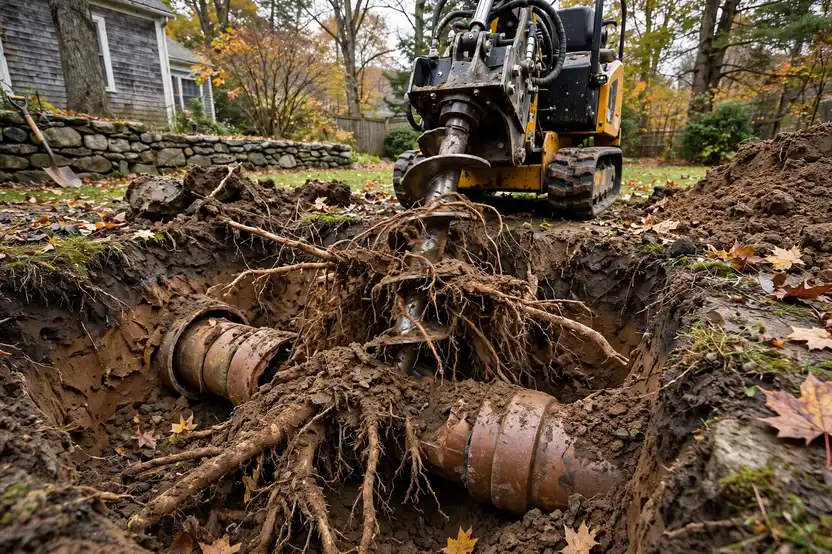
Long Laterals, Deep Roots in Lynnfield
Lynnfield's root story is written in lot sizes. With a median lot near 24,000 square feet and laterals commonly running 60 to 100-plus feet from house to curb, the pipe spends most of its length threading through the root zones of mature shade trees — and the 1950s–60s cast-iron-plus-clay systems are all reaching end of life on the same schedule, so cluster failures by street are common. Roots don't enter at one joint; they enter at half a dozen, and a partial cutting leaves the rest.
That length is exactly why mechanical cutting and camera inspection are paired here. The cutters clear each root mass, and the camera maps the full run, joint by joint, so the homeowner sees which segments are holding and which have become root hotels. Open trenching across 100 feet of landscaped lawn and paved driveway would destroy the property's curb appeal — the cutter-and-camera approach works entirely from cleanouts and leaves the landscaping untouched.
Root treatment after a full-length cutting is what makes the interval between visits reasonable on these long runs. Applied to the cleared joint line, treatment suppresses regrowth without harming the mature trees that make Lynnfield lots what they are — nobody wants to lose a 60-year-old shade tree to save a clay joint. With deep finished basements below, keeping those joints clear is also backup prevention: a root-choked joint on a 90-foot run backs up into the lowest fixture first, and that's usually the finished basement.
Full-Length Root Cutting for Lynnfield Laterals
Lynnfield root jobs are run as full-length operations, because the laterals demand it. A 60 to 100-plus foot run from house to curb crosses the root zones of a half-dozen mature shade trees, and the 1950s–60s cast-iron-plus-clay joints have been admitting roots at several points at once for years. The cable-fed cutter travels the entire lateral in one pass, shredding each root mass and reaming every joint back to its original bore — a partial cutting on a run this long just moves the blockage to the next joint.
The camera survey is the heart of the Lynnfield service. With dozens of joints along a long run, the footage grades each one — sound joints with light root hair, joints packed solid, bells offset by frost heave — and that grading becomes the property's pipe record. Because whole subdivision cohorts are aging out together, that record is also predictive: the joint pattern on your lateral today is what your neighbors' laterals will show next year. Joints graded sound receive foaming treatment; joints graded failed are flagged for trenchless repair before they become emergencies.
Treatment is applied along the cleared joint line to suppress regrowth from the root crowns without harming the mature shade trees that define Lynnfield lots — losing a 60-year-old tree to save a clay joint is never the trade anyone wants. And because the basements below are deep and finished, the service doubles as backup prevention: a root-choked joint on a 90-foot run backs up at the lowest fixture first. Everything runs through cleanouts, so the landscaped lawn, the long paved driveway, and the finished basement all stay exactly as they were.
Why Lynnfield's Big Lots Mean Big Root Jobs
Lot size is the first driver. At a median near 24,000 square feet, Lynnfield laterals commonly run 60 to 100-plus feet from the house to the curb, and nearly all of that length threads through the root zones of mature shade trees. More pipe in the root zone means more joints exposed — roots don't enter at one joint on a run this long, they enter at half a dozen, and each one can independently block flow.
Cohort aging is the second driver. The town's 1950s–60s cast-iron-plus-clay systems were installed as subdivision cohorts, and they're reaching end of life on the same schedule — which is why cluster failures by street are common in Lynnfield. When one lateral's joints pack solid with roots, the neighbors' laterals are usually months, not years, behind. The pipe era is uniform, the tree cover is uniform, and the failure timing follows.
The finished basement is the third driver. Lynnfield's 1950s–70s stock typically has deep, finished basements, which means a root blockage 80 feet out announces itself as a backup in the most expensive room in the house. Long paved driveways and extensive landscaping make open trenching destructive as well as expensive. The combination — long laterals, aging cohorts, finished basements, valuable landscaping — is why the full-length cut, camera-map, and treat cycle is the standard here rather than the exception.
Root Removal Process in Lynnfield
Cleanout location and run measurement
We find the cleanouts and measure the lateral's full length — on these lots the run is often 60 to 100-plus feet, and that length shapes the entire job.
Single-pass full-length cutting
The cutter travels the whole lateral in one continuous pass, clearing root masses at every joint and reaming each bell back to full bore.
Joint-by-joint grading on camera
Every joint along the run is filmed and graded, producing a pipe record that shows which joints are sound, which are packed, and which have structurally failed.
Joint-line treatment, landscape untouched
Cleared joints receive foaming treatment that slows regrowth without harming mature shade trees — lawn, driveway, and plantings stay exactly as they were.