
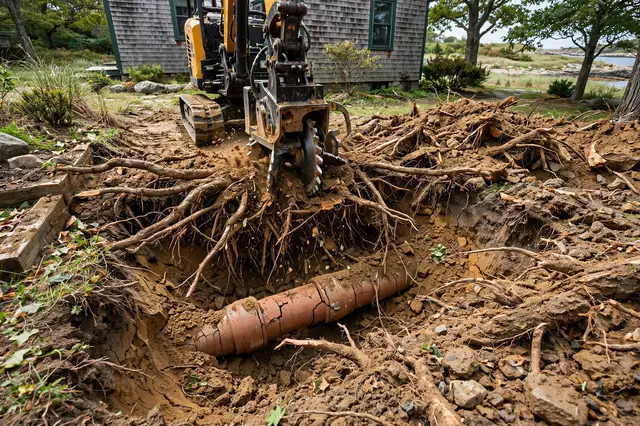
Root Treatment on a Peninsula Sewer System
Nahant's sewer system is a single, town-wide network feeding the Lowlands Pump Station, and the town is already spending on inflow-and-infiltration rehabilitation — including root treatment, joint sealing, and grouting — which tells you where roots stand in the local priority list. The 1870–1910 summer homes and Victorians that make up the historic core typically carry clay tile laterals and cast-iron stacks, and their joints have had a century of root exposure in thin, rocky peninsula soils.
Ledge near the surface on the rocky sections complicates everything: roots in thin soil concentrate on the pipe trench as the only easy digging, and excavation that hits bedrock is slow enough that cutting-and-treatment inside the pipe is the rational first and second move. In the Lowlands and waterfront properties, tidal-influenced infiltration rides in with the roots through the same joints — cutting clears the blockage, and the camera shows whether the joint is also admitting groundwater that the town's I&I program is trying to keep out of the pump station's flow.
With one land route — the Causeway — into town, equipment staging is a real constraint, which is another reason Nahant root work favors compact cutter-and-camera jobs through existing cleanouts. For homeowners, the message is straightforward: the town is rehabilitating its side of the system, and keeping the private lateral's joints clear of roots with a cutting-and-treatment cycle keeps the home's side from becoming the weak link the DPW flags next.
Compact In-Pipe Root Service for Nahant
The service in Nahant is compact by necessity. Everything — cutter, camera, treatment — arrives as cable-fed equipment that enters through an existing cleanout, because the town's single land route over the Causeway makes staging large rigs impractical and the rocky peninsula makes excavation slow wherever ledge sits near the surface. The cutter head shreds the root mats packed into the clay tile joints of the 1870–1910 summer homes and Victorians and reams each joint back to full bore — the whole lateral worked from inside the pipe.
The camera survey is read with the town's system in mind. Nahant is actively rehabilitating its collection system for inflow and infiltration — root treatment, joint sealing, grouting — which means private laterals get noticed when they contribute. The footage grades each cleared joint for root damage and for groundwater entry: in the Lowlands and waterfront properties, tidal-influenced infiltration rides in with the roots, and a joint admitting both is a joint the town's I&I program would rather see sealed than repeatedly cut.
Joints the camera grades as sound receive a foaming treatment that checks regrowth from the root crown through the growing season. On the rocky sections, where thin soil concentrates every nearby root system on the pipe trench, treatment is what keeps the interval between cuttings reasonable. For Nahant homeowners the logic is simple: the town is investing in its side of the system, and a cutting-and-treatment cycle on the private lateral keeps the home's side from becoming the weak link — all without excavation on a peninsula where digging is impractical.
Why the Peninsula Pushes Roots Into Sewers
Thin rocky soil is the first driver. Nahant is a tied-island peninsula known for its rocky coasts, with ledge near the surface across the rocky sections. In that thin profile, a leaking clay joint is the only easy digging for blocks — roots concentrate on the pipe trench instead of spreading through deep soil, packing joints with unusual density. The 1870–1910 summer homes and Victorians carry clay tile laterals whose joints have had a century of that concentrated pressure.
Tidal infiltration is the second driver. In the Lowlands and waterfront properties, tidal-influenced groundwater enters through the same joints the roots occupy, keeping seals degraded and the root pathway permanently open. The town's own I&I rehabilitation — targeting high-priority inflow and infiltration with root treatment and joint sealing — confirms this is a system-wide pattern, not a house-by-house anomaly.
Access constraint is the third driver. With the Causeway as the single land route into town, heavy excavation equipment is difficult to stage, and ledge near the surface makes any digging that does happen slow and expensive. That combination — concentrated root pressure, tidal infiltration, and no practical excavation option — is why the compact in-pipe cutting, camera, and treatment cycle isn't just the convenient choice in Nahant but the only one that fits the peninsula.
Root Removal Process in Nahant
Causeway-friendly cleanout entry
Compact cable-fed equipment enters through an existing cleanout — no large rigs staged over the Causeway, no excavation in shallow ledge. All gear arrives compact and cable-fed — nothing that needs staging room the Causeway can't provide. The visit footprint stays small enough for the peninsula's single access road.
Full-lateral root cutting
The cutter shreds root mats at each clay joint of the historic-core laterals and reams the joints back to full bore, entirely from inside the pipe. The cutter works the full lateral of the 1870–1910-era clay joints without touching the shallow ledge around the pipe.
I&I-aware camera grading
Each cleared joint is filmed and graded for root damage and tidal-influenced infiltration — joints admitting both are flagged for sealing, not just treatment. Lowlands and waterfront joints are graded for tidal-influenced infiltration, matching the town's I&I priorities. That keeps the private lateral aligned with the town's system-wide I&I goals.
Foaming treatment on sound joints
Foaming treatment goes onto the cleared sound joints, holding regrowth down from the root crown so the private lateral never becomes the system's weak link. Keeping the private lateral treated means the home's side never becomes the weak link the DPW flags.