
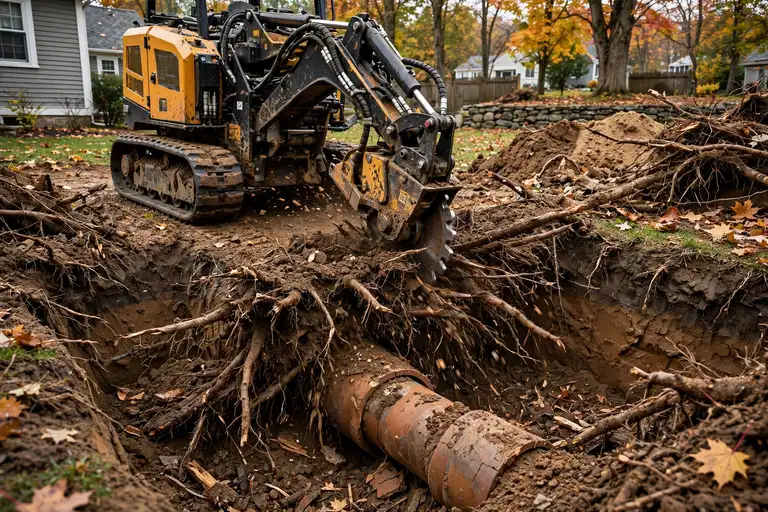
Root Intrusion on North Reading Acre Lots
North Reading's acre-sized lots turn root intrusion into a long-run problem. Laterals commonly stretch 100 feet or more across landscaped yards to reach the street, threading through the root zones of the mature trees in the town's wooded neighborhoods the whole way. Pre-1960 capes and ranches with clay tile laterals are the prime candidates — every joint along that long run is a potential entry point, and roots enter at several at once.
The Martins Brook and Ipswich River flood corridor adds groundwater to the equation: laterals in the southern half of town face seasonally high water tables, and roots follow the moisture straight to leaking joints, especially where the pipe crosses wetland buffers along the brook. Mechanical cutting restores flow along the full run, and the camera maps every joint so treatment can be applied where the roots actually are — not guessed at.
Trenchless-first thinking matters doubly here. Open excavation across 100-plus feet of landscaped acreage is disruptive and expensive, and any digging near the brook corridor brushes against permit-sensitive wetlands — cutting, camera, and treatment all happen inside the existing pipe, keeping the work out of the buffer zones entirely. For North Reading homeowners, a full-length cutting-and-treatment cycle every few years, verified by camera, is how a long lateral under mature trees stays open without ever opening the yard.
Long-Run Root Cutting for North Reading Acreage
The service in North Reading is scaled to the lots: laterals of 100 feet or more, running from pre-1960 capes and ranches across landscaped acreage to the street. A cable-fed cutter travels the entire run in one continuous pass, shredding the root mats that have been thickening at the clay tile joints for decades, reaming every joint back to its original bore. On a run this long, roots enter at several joints at once — a spot cutting just hands the blockage to the next joint down the line.
The camera survey maps the full run joint by joint, and in North Reading that map has two jobs. First, it grades every clay joint for root damage — sound, packed, or failed — so the foaming treatment goes exactly where the roots are. Second, on the southern half of town, it reads groundwater: laterals in the Martins Brook and Ipswich River flood corridor face seasonally high water tables, and where the pipe crosses wetland buffers along the brook, the camera checks whether infiltration is entering with the roots. A joint admitting both is flagged for sealing, because treatment alone can't hold against constant groundwater.
Along the cleared joint line goes a foaming treatment that damps down regrowth from the root crowns, leaving the mature trees of the wooded neighborhoods untouched. The in-pipe approach has a second payoff here that excavation can't match: nothing is dug near the brook corridor, so the work never enters permit-sensitive wetland buffers. For a 100-foot lateral under mature trees, the full-length cut, camera-map, and treat cycle every few years is what keeps the yard intact and the line open.
What Makes North Reading a Long-Run Root Town
Acre lots are the first driver. With residential lots of at least an acre the norm, North Reading laterals commonly stretch 100 feet or more across landscaped yards — with nearly all of it passing through the root zones of the mature trees in the town's wooded neighborhoods. Every clay tile joint along that run is a potential entry point, and on a run this long, roots don't pick one joint; they colonize several at once.
The brook corridor is the second driver. Martins Brook originates at Martins Pond and runs through town to the Ipswich River, with a documented floodplain along its course — and laterals in the southern half of town sit in that corridor's seasonally high water tables. Roots follow moisture relentlessly, and where the pipe crosses wetland buffers along the brook, a leaking joint becomes the most attractive target in saturated ground. That groundwater pressure is also why infiltration rides in with the roots here.
The housing mix is the third driver. Pre-1960 capes and ranches carry the clay tile laterals most vulnerable to joint intrusion, while the 1960s–80s expansion stock and newer custom homes on the same acre lots are growing their own root exposure as their landscaping matures. Across all eras, the lots are large, the trees are mature, and the runs are long — the combination that makes root intrusion a full-length problem rather than a spot problem, and the in-pipe cycle the approach that doesn't tear up an acre to fix it.
Root Removal Process in North Reading
Cleanout location across the acre
We find the cleanouts and confirm the lateral's full length — on these lots the run is commonly 100 feet or more, and that shapes the entire job. Run length is measured first — acre-lot laterals commonly exceed 100 feet, and that sets the visit plan.
Continuous full-run cutting
The cutter travels the whole lateral in one pass, shredding root mats at every clay joint and reaming each bell back to full diameter. The single continuous pass avoids leaving any joint uncut on runs with dozens of entry points.
Joint map plus groundwater read
The camera grades every joint for root damage and checks brook-corridor sections for infiltration entering with the roots.
Foaming treatment, buffers untouched
Cleared joints receive foaming treatment that slows regrowth — all inside the existing pipe, keeping the work out of wetland buffer zones entirely.