
Trenchless Sewer Repair That Fits Beverly's Tight Downtown Blocks and Harbor Soil
Beverly is one of the oldest housing stocks on the North Shore — 43 percent of homes were built before 1939, with downtown colonials and oceanfront Victorians sitting on clay-tile laterals and century-old cast iron. Those lines have spent decades absorbing freeze-thaw heave, root pressure from mature street trees, and joint offset, so a camera inspection is the starting point of every trenchless job here. What the camera usually finds is cracked hubs and separated joints rather than collapsed pipe, which is exactly the damage profile cured-in-place lining is built to handle: the liner bridges the gaps and seals the joints from the inside, without a trench across the yard.
The layout of the town makes that low-dig approach more than a convenience. Around Cabot Street and the dense downtown blocks, narrow streets leave almost no room to stage an excavator, store soil, and keep a lane open for traffic. Two small access pits — one at the house, one at the curb — let a crew reline or burst a lateral while the street stays open. That same tight frontage means an open trench would often mean cutting through brick sidewalks and curbs that fall under municipal repair rules, adding weeks and restoration costs a trenchless job simply sidesteps.
Beverly's coastal half brings one more consideration before any liner goes in. Low areas near the harbor and the tidal-marsh inlets sit on very poorly drained muck soils, and the water table runs high, so groundwater infiltration has to be checked before lining — water pushing in through open joints can compromise a liner if the joints are not sealed first. Along oceanfront roads, the saltwater-influenced soil also calls for a corrosion assessment of older cast iron. In this setting, trenchless is not just cleaner — when infiltration is measured and joints sealed, a watertight liner is often the more reliable repair than a trench in saturated, slumping ground.
How Trenchless Sewer Repair Works on Beverly's Older Laterals
Trenchless sewer repair renews a failing lateral without an open trench, using one of two approaches. Cured-in-place pipe lining inserts a resin-saturated liner into the existing pipe and cures it hard, creating a smooth, jointless new pipe inside the old one. Pipe bursting pulls a bursting head through the old line, fragmenting it outward while drawing a new high-density pipe in behind. In Beverly, lining is the usual answer for clay tile with cracked hubs and offset joints, while bursting fits lines that have collapsed sections or need a larger diameter.
The harbor side of town adds a step most inland jobs skip. Because the water table runs high near the harbor and tidal inlets, a trenchless crew measures groundwater infiltration before choosing a method — inflowing water must be managed so the liner cures against a dry, stable surface and every joint seals fully. That pre-check is also where saltwater-influenced soil gets flagged for a corrosion assessment on older cast iron. Done in this order, the watertight result holds up in saturated ground that would make an open trench slump and stall.
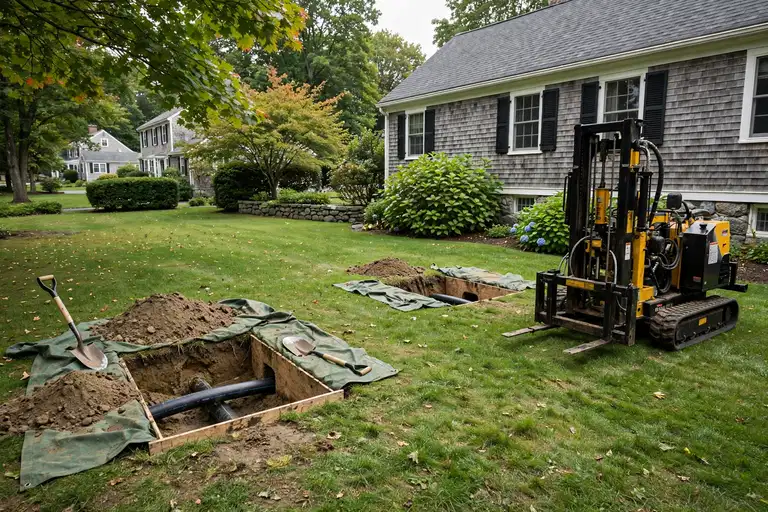
Staging is where Beverly's downtown geography favors the method. Around Cabot Street and the older blocks, there is rarely room for an excavator, a spoil pile, and a traffic lane at once. A trenchless job works from two small pits — one at the foundation, one at the curb — so the street stays open and brick sidewalks and curbs are never cut. The landscaping, driveway, and plantings above the line survive the repair, and the work typically finishes in days rather than the weeks an open-trench project with municipal surface restoration can take.
Is Trenchless the Right Call for a Beverly Property?
Start with the soil. Upland Beverly sits on Essex-series glacial till — gravelly sandy loam over dense hardpan — which digs reasonably but heaves with frost; the low areas near the harbor and tidal inlets sit on very poorly drained marsh muck with a high water table. In the muck zones, open trenches fill with water and their walls slump, while a liner installed inside the existing pipe never opens the ground at all. Where the ground is wettest, trenchless is not just tidier — it is the more buildable repair.
Next, the pipe itself. With 43 percent of Beverly homes built before 1939, clay-tile laterals with root intrusion and century-old cast iron with scale and bellies are the common finds, and a camera pass maps which sections are lineable and which need bursting. Oceanfront and marsh-adjacent properties add saltwater-influenced corrosion on old cast iron, which the assessment catches before work begins. The candidacy test is straightforward: if the pipe still has a bore to follow, lining seals it; if it has collapsed, bursting replaces it — either way without a trench.
Finally, access. Narrow downtown streets around Cabot Street limit equipment staging so severely that open-trench work often becomes a traffic and restoration project as much as a pipe project. Two pits avoid that entirely. For oceanfront Victorians and downtown colonials alike, the combination of old pipe, tight streets, and high groundwater makes Beverly one of the stronger trenchless candidacies on the North Shore.
Our Trenchless Process in Beverly
Camera and infiltration survey
We run a camera the full length of the lateral, map every offset joint and root entry, and measure groundwater infiltration — critical on harbor-side streets — so the method matches the pipe's real condition.
Liner or burst plan
Cracked but continuous pipe gets a cured-in-place liner; collapsed or undersized sections get pipe bursting. You see the footage and the plan before any work starts.
Two-pit installation
Small access pits go in at the house and the curb. The liner is installed and cured, or the new pipe is burst through — with the street open and the yard intact.
Verification and restoration
A post-install camera pass and flow test confirm a clean, sealed line, then the pits are backfilled and the surface restored to match.