
Why Burlington's Long Suburban Laterals Suit Pipe Lining
Burlington is the quintessential Route 128 post-war suburb, with a median build year of 1963 and a housing stock of ranches, split-levels, and split-entry homes. The laterals of concern here are the era's clay tile and aging cast iron, and the full basements under these homes — many finished as living space — make cured-in-place lining attractive for a practical reason: the pipe is renewed from access points outside the house, so nobody is cutting through a finished basement slab or tearing up a rec room to reach a failed line. A crew can rehabilitate the lateral while the lower level stays intact.
The geometry of these homes is the other half of the story. Split-entry designs run the sewer exit deeper and farther to the street main, and laterals on Burlington's generous lots routinely stretch 60 to 100 feet or more, threading under mature shade trees, long driveways, and landscaped yards. Excavating a full-length trench through all of that is disruptive and slow; lining the same run from two pits preserves the lawn, the driveway, and the tree roots that caused the problem in the first place. Root intrusion at clay joints under driveways and lawns is the signature failure here, and a jointless liner removes every one of those entry points in a single pass.
One caution comes from the town's water geography. Brook-adjacent lots along Vine Brook and Sandy Brook corridors carry seasonal high groundwater, so infiltration testing and proper liner curing conditions matter on those properties — a liner installed against inflowing water needs the water managed first. Town wetland regulations also surround any open-trench work near protected areas with permitting, while trenchless rehabilitation works inside the existing pipe envelope. For Burlington's 1950s–60s stock, that combination — finished basements, long root-crossed runs, and protected wetland edges — is exactly what trenchless methods were made for.
Lining Long Laterals: The Trenchless Approach for Burlington Homes
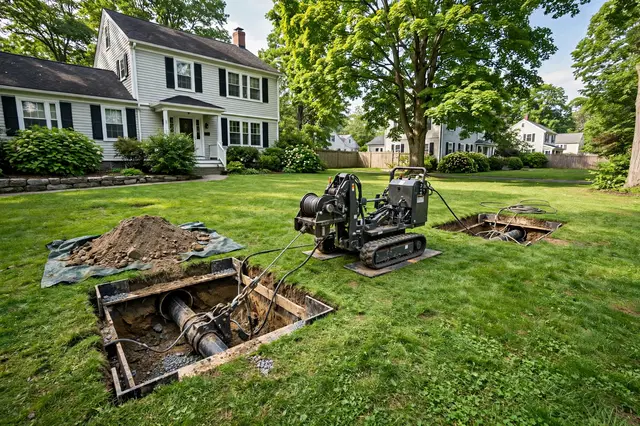
Burlington's laterals are long, and length changes the economics of every repair method. A cured-in-place liner is installed from an access pit at each end of the run and cures into a continuous new pipe — whether that run is 40 feet or 110 feet, the surface disruption stays at two pits. Excavating the same distance means opening a trench across the entire yard, and on split-entry homes where the sewer exits deeper and farther from the street, that trench gets deep as well as long. For these geometries, lining is not a shortcut; it is the proportionate response.
The method also respects what sits above the pipe. Burlington's ranches and split-levels typically have full basements, many finished as living space, and trenchless renewal happens entirely outside the house — no cutting through a basement slab, no tearing up a finished lower level to reach a failed connection. Above ground, the liner passes under mature shade trees, long driveways, and established lawns without disturbing them. Root intrusion at clay joints under driveways is the signature failure here, and a jointless liner removes every entry point along the run in a single installation.
Near the brook corridors — Vine Brook, Sandy Brook, Long Meadow Brook — the work gets one extra discipline. Seasonal high groundwater means infiltration testing before lining and proper curing conditions during it; a liner installed against unmanaged inflow will not seal correctly. Town wetland regulations add a second reason to stay trenchless near protected areas: rehabilitation inside the existing pipe needs no buffer-zone permitting, while open trenching near wetlands invites it. Length, finished basements, tree roots, and wetland edges — Burlington's laterals were practically drawn for this method.
Does Your Burlington Lateral Qualify for Trenchless Repair?
Check the pipe's era first. The core Burlington stock — 1950s to early-60s ranches and split-levels at the 1963 median build year — runs cast iron inside with clay tile or Transite laterals outside, both now at an age where joint failure and root intrusion are routine. A camera inspection shows whether the bore is continuous enough to line or whether a section needs bursting. Either way, the era's pipe is the prime trenchless candidate: old enough to fail at the joints, intact enough to renew from the inside. Split-entry designs run their sewer exits deeper to the street main, so the footage saved by lining grows with every foot of depth.
Check the water second. Brook-adjacent lots carry seasonal high groundwater, and the town's wetland bylaws protect marshes, wet meadows, bogs, and vernal pools across large areas. Lining seals infiltration along the full run — the right fix where groundwater is the complaint — and because the work never leaves the pipe envelope, wetland buffers are never disturbed and no special excavation permitting enters the picture. Ongoing storm-drainage projects near Wheeler Road show the town treats groundwater as a municipal issue, and lining treats it as a pipe issue.
Check the surface third. Long paved driveways, mature trees, irrigated lawns, and finished basements are exactly what open trenching destroys and trenchless preserves. Split-entry homes with deeper, longer runs benefit most, since per-foot digging costs climb with depth. When the pipe is lineable, the water is high, and the surface is valuable, Burlington answers yes on all three counts. Interior slab transitions in split-levels get epoxy lining from inside access points.
Our Trenchless Process in Burlington
Camera mapping of the full run
We film the entire lateral — often 60 to 100+ feet — logging every joint, root mass, and belly, and test for groundwater infiltration on brook-adjacent lots. recording the exact run length for liner fabrication.
Method matched to length and condition
Continuous runs get a full-length cured-in-place liner; collapsed or undersized sections get pipe bursting. The plan accounts for the actual measured run length. with the measured footage driving the choice.
Pit-to-pit installation
Access pits at the house and curb (or property line) let us install and cure the liner with the lawn, driveway, and trees untouched. scheduled around the household's routine.
Cure verification and flow test
We confirm the liner cured fully and the line flows clean on camera, then restore the two pits — no trench restoration across the yard. plus a copy of the before-and-after footage.