
Where Granite Meets the Road: Trenchless Repair on Cape Ann's Ledge
Gloucester is the ledge town, and that fact shapes every sewer repair here. Thin, rocky glacial soil sits over granite that outcrops all over Cape Ann — the USDA's Annisquam soil series was typed in Gloucester itself, with dense till and 5–25 percent cobbles and stones just 20–30 inches down. Open-trench replacement on these streets routinely turns into rock excavation, and on a residential budget that is the expensive exception, not the norm. Pipe bursting or cured-in-place lining, which renews the line inside its existing bore without cutting through ledge, is the cost-effective default — and any honest estimate here should say so plainly.
The town's 400-year layering of housing complicates the other end of the job. Sea-captain-era homes around East Gloucester Square and Middle Street sit on shallow stone and rubble cellars with retrofitted clay and cast-iron laterals — the highest-risk combination — so camera inspection is mandatory before any method is chosen. The camera has to map exactly where the pipe dives under ledge and where the old joints are, because lining a line with a fully collapsed section or an unmapped obstruction wastes everyone's time. Near the Inner Harbor, infiltration from high groundwater has to be ruled out before lining, for the same reason it must be in every coastal town.
Steep, narrow streets add the third constraint: Rocky Neck, the East Gloucester hills, and Washington Street in Lanesville were not laid out for heavy equipment. Compact trenchless rigs fit where an excavator and a spoil truck cannot, and the work finishes without closing a hill street for days. For Gloucester, trenchless is not merely less digging — on ledge ground it is often the difference between a repair a homeowner can afford and one they cannot.
Why Ledge Country Calls for Trenchless Pipe Renewal
Gloucester's geology rewrites the usual repair math. Where most towns compare lining against digging, Gloucester compares lining against drilling — because trenching through granite ledge and bouldery till means rock excavation, with costs that escalate far beyond a residential pipe budget. Cured-in-place lining sidesteps the rock entirely: the resin liner goes in through the existing pipe and cures into a new jointless line, never asking what the ground around it is made of. Pipe bursting works the same alignment without cutting stone. On ledge, trenchless is not the gentle option; it is the affordable one.
The method choice follows what the camera finds underground. Gloucester's retrofitted laterals — mid-20th-century clay and cast iron serving 18th- and 19th-century homes — need mapping first: exactly where the pipe dives under ledge, where joints have offset, where roots have entered. Continuous pipe with joint damage gets a liner; collapsed sections get bursting. Near the Inner Harbor, the survey adds an infiltration check, because high groundwater pressing into open joints will compromise a liner that is installed without the water managed first.
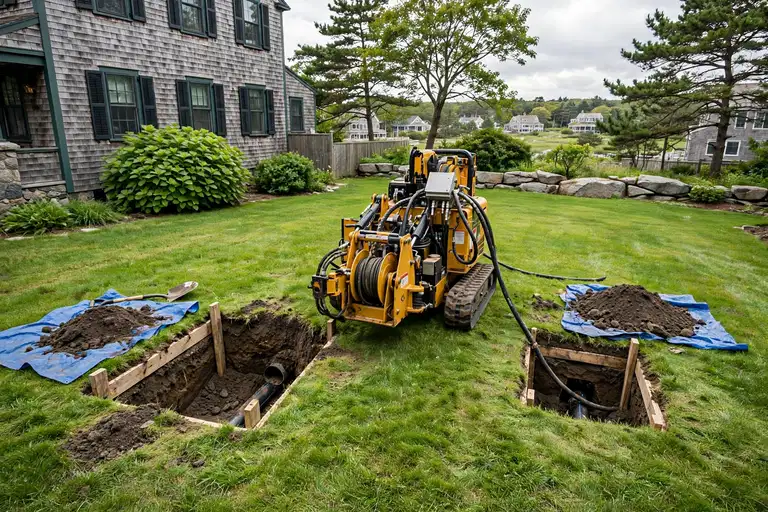
The street layout seals the argument. Steep, narrow lanes in Rocky Neck, the East Gloucester hills, and Lanesville were never designed for excavators and spoil trucks, but compact trenchless rigs set up in two small pits and keep those streets passable. The work finishes without closing a hill road for days and without hauling rock spoil through a fishing village. For Gloucester, minimal digging is not a marketing phrase — it is the only way the job fits the town.
Trenchless Candidacy on Cape Ann's Granite
The soil profile is the headline. The Annisquam series — typed in Gloucester itself — is fine sandy loam over dense till at just 20–30 inches, carrying 5–25 percent cobbles and stones, with granite ledge outcropping across Cape Ann. Laterals lie in shallow rock trenches with poor cover. Any estimate that proposes open-cut replacement here without naming the rock risk is incomplete; trenchless lining or bursting, which never leaves the existing bore, removes that risk from the bid entirely. The Annisquam series was typed in Gloucester itself, so the cobbly, shallow profile is documented ground truth, not guesswork.
The pipe stock is the second factor. Sea-captain-era homes around East Gloucester Square and Middle Street sit on shallow stone and rubble cellars with retrofitted clay and cast-iron laterals — the highest-risk combination in the set — so camera inspection is mandatory and the method is chosen per section. Harbor-adjacent low pockets add saturated soil and infiltration, which the pre-lining water check rules out before work begins. Harbor-adjacent low pockets add saturated soil to the rock, which is why the pre-lining water check is non-negotiable here.
Access is the third. Steep grades, tight lot lines, and narrow historic streets defeat full-size excavation equipment, while two-pit trenchless setups fit. Add storm-surge exposure around the Inner Harbor and coves — where backwater protection belongs in the same conversation as the pipe repair — and Gloucester's candidacy is complete: rock below, old pipe in the middle, tight streets above, and a method built for exactly that stack. Washington Street in Lanesville and the East Gloucester hills were laid out long before excavation equipment existed.
Our Trenchless Process in Gloucester
Ledge-mapping camera survey
We film the lateral and map precisely where the pipe runs under ledge, through cobbly till, or in shallow rock trench — plus every joint, offset, and root entry — and test harbor-side infiltration. distinguishing soil-bored from rock-trenched sections.
Rock-aware method selection
Lineable runs get a cured-in-place liner; collapsed sections get pipe bursting. The plan is priced against rock excavation avoided, so you see the comparison. with the rock-excavation savings shown plainly.
Compact two-pit installation
Small rigs work from pits at the house and curb, renewing the line inside its existing bore. Steep narrow streets stay open; no rock spoil leaves the site. and no rock spoil to haul away.
Camera-verified watertight finish
A final pass confirms the jointless renewal and sealed joints, then pits are restored. On low harbor streets we review backwater-valve protection as well. documented with before-and-after footage.