
Trenchless Repair Over Marblehead's Shallow Bedrock
Marblehead has the hardest sewer geology on the North Shore. The town sits on hard Proterozoic rhyolite with frequent bedrock outcrops, covered by only a thin skin of glacial till — so laterals often lie in shallow rock trenches with poor soil cover, and open-trench replacement regularly turns into rock excavation. That changes the math completely: where digging means drilling and blasting through rhyolite, trenchless lining or pipe bursting — which renews the pipe inside its existing bore — is frequently the only economical path, not a luxury upgrade. The camera's first job here is to map exactly where the pipe dives under ledge, so the method matches the ground.
The surface above the pipe is just as constrained. In the Old Town historic district, nearly 300 pre-Revolutionary homes stand along narrow, winding streets, and exterior alterations fall under preservation approval — digging up a landmarked streetscape to replace a lateral is slow, permitted, and expensive in restoration. Compact trenchless rigs work from small pits, keep the cobbles and curbs untouched, and avoid the approval gauntlet that surface disturbance triggers. Tight lot lines and winding streets that defeat equipment staging are a practical argument for minimal-dig methods all on their own.
Near the harbor and the Neck, the town's own design standards document finished grade less than four feet above the water table in places — a high water table confirmed locally — and nor'easter surge plus salt air accelerate corrosion of exposed cast-iron components. That means infiltration checks before lining are standard practice here, and watertight joint sealing matters as much as the structural renewal itself. Shallow rock below, high water around, and historic streets above: Marblehead is the textbook case for why trenchless methods exist.
Renewing Pipe Over Shallow Bedrock Without Digging Rock
Marblehead's ground makes the method decision simple. Laterals lie in shallow rock trenches cut into Proterozoic rhyolite, covered by only a thin skin of glacial till — so open-trench replacement means excavating rock, with costs and timelines that leave the residential budget behind. Cured-in-place lining never asks the ground for permission: the liner travels the existing bore and cures into a new jointless pipe, whether that bore runs through soil or stone. Pipe bursting does the same with a brand-new pipe. Where digging means drilling, trenchless is the economical path by a wide margin.
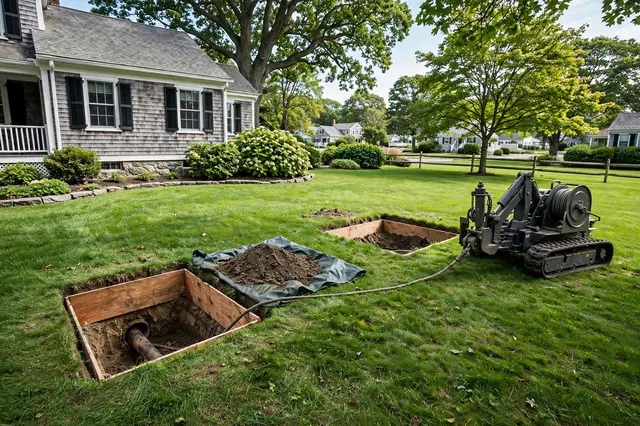
Above ground, the town's historic fabric reinforces the choice. Old Town's nearly 300 pre-Revolutionary homes stand on narrow, winding streets where exterior alterations need preservation approval — digging up a landmarked streetscape to replace a lateral is slow, permitted, and costly to restore. Compact trenchless rigs work from two small pits, leave cobbles and curbs untouched, and avoid the approval process that surface disturbance triggers. Tight lot lines that defeat equipment staging are a practical argument for minimal digging on their own.
Near the harbor and the Neck, the work adds a water discipline. The town's own standards document grade less than four feet above the water table in places, and nor'easter surge plus salt air corrode exposed cast iron. Infiltration testing precedes every liner here, and watertight joint sealing matters as much as structural renewal. Shallow rock below, high water around, historic streets above — Marblehead is the textbook case for trenchless, and the installation follows that textbook: measure water, map rock, renew from two pits.
Is Trenchless Right for Your Marblehead Property?
Check the rock first. Hard rhyolite with frequent outcrops and thin till means limited soil cover over pipes — laterals in shallow rock trenches are the norm, not the exception. Open-cut replacement in this ground is rock excavation; lining or bursting inside the existing bore never meets the rock. If your street shows ledge at the surface, trenchless is almost certainly the economical answer. If your street shows ledge at the surface, the economical answer is usually decided before the camera even goes in.
Check the pipe's generation second. Pre-1960 Marblehead runs vitrified clay laterals with cast-iron stacks — the 20th-century clay-and-iron generation that now shows joint failure and root intrusion — while Colonial-era homes have been re-piped multiple times, so the camera, not the house's age, identifies what is actually underground. Continuous bores line; collapsed sections burst. The 20th-century clay-and-iron generation is what the camera expects to find, and it usually does.
Check the street and the water third. Old Town's winding lanes and preservation approvals punish surface disturbance, while the documented high water table near the harbor demands infiltration checks before lining and makes watertight sealing a co-equal goal. Rock, old pipe, historic street, high water — when three or four of these are true, trenchless is not just preferred, it is the practical necessity. When three or four of these factors are true at once, trenchless stops being a preference and becomes the practical necessity.
Our Trenchless Process in Marblehead
Bedrock-aware camera survey
We film the lateral and map exactly where the pipe runs under ledge or in shallow rock trench, log every joint and root entry, and test infiltration on harbor-side properties. with ledge depth and rock-trench routing recorded.
Method matched to ground and pipe
Lineable runs get a cured-in-place liner; collapsed sections get bursting. The plan is drawn against rock-excavation costs avoided. avoiding the rock-excavation line item entirely.
Preservation-safe installation
Two small pits and compact rigs renew the line with streetscapes, cobbles, and curbs untouched — no preservation-approval excavation. keeping cobbles, curbs, and streetscapes intact.
Watertight verification
A final camera pass confirms the jointless, sealed renewal; on harbor properties we review backwater protection against surge-driven backup. with surge protection reviewed where warranted.