
Trenchless Fixes for Middleton's House-to-Tank Sewer Lines
Middleton is the outlier of this set: about 99 percent of homes are on septic, so 'sewer line repair' here almost always means the building sewer — the line from the house to the septic tank — not a municipal lateral. The failure points follow the town's two housing eras. In older farmhouses, the classic break is the cast-iron-to-PVC transition at the foundation wall, where a later septic retrofit meets the original iron. In the post-2000 subdivisions, the work skews toward inspection, root intrusion at tank inlets, and grading or drainage fixes around newer PVC. Trenchless methods fit both: a short burst or liner run renews the house-to-tank line from small pits, without an open trench across a yard that drains toward the town's wetlands.
Those wetlands are the constraint that shapes every job. Middleton sits in wetland-rich terrain — a documented red maple swamp complex with peat bog and nine interconnected ponds — with seasonally high water tables and poorly drained till soils. Excavation near those resource areas runs into buffer-zone scrutiny, and shallow saturated trenches are miserable to build in. Trenchless rehabilitation works inside the existing pipe envelope, so the repair never touches the wetland buffer, the lawn stays whole, and the crew is not fighting groundwater in an open cut. Where the old line runs through a wet corner of the lot, staying in the pipe is the workable answer.
The town's on-site-system rules add a procedural layer: Middleton Board of Health requirements — installer permits, inspections, pressure testing of sewer lines — govern building-sewer work here. A trenchless contractor plans for those inspections the same as any other method, but the shorter job footprint and sealed result make compliance straightforward. For a town where nearly every home's 'sewer' is a private line to a tank, the quiet, low-dig renewal that leaves the yard, the wetlands, and the leach field undisturbed is the natural fit.
Trenchless Renewal for Middleton's House-to-Tank Lines
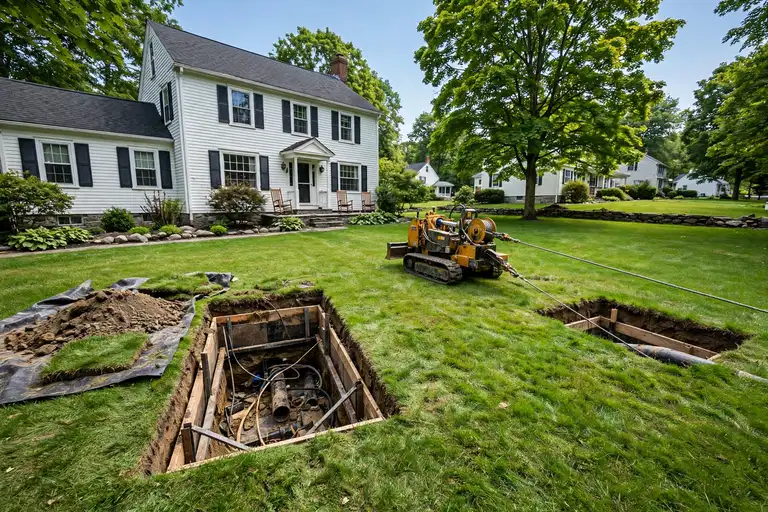
In Middleton, the 'sewer line' is the building sewer: the pipe from the house to the septic tank. Trenchless methods adapt to it directly. Cured-in-place lining renews a continuous run from two small pits — typically at the foundation exit and the tank inlet — creating a jointless pipe inside the old one. Pipe bursting replaces collapsed or compromised sections with new pipe along the same alignment. For older farmhouses, the classic failure is the cast-iron-to-PVC transition at the foundation wall, where a later septic retrofit meets the original iron; for post-2000 subdivisions, it is root intrusion at tank inlets and settling around newer PVC. Both are trenchless jobs.
The town's wetland geography is what makes the no-dig approach more than convenient. Middleton's red maple swamp complex, peat bog, and nine interconnected ponds come with buffer zones where excavation faces scrutiny — and the seasonally high water table makes open trenches in those areas miserable to build. Trenchless rehabilitation stays inside the existing pipe envelope, so the repair never enters a buffer zone, never disturbs protected ground, and never fights groundwater in an open cut. The yard, the wetlands, and the leach field all stay exactly as they were.
The procedural side is straightforward. Middleton Board of Health rules govern on-site systems — installer permits, inspections, pressure testing of sewer lines — and a trenchless contractor plans for those inspections like any other method. The sealed, jointless result actually simplifies compliance: pressure testing a continuous lined pipe is cleaner than testing a jointed one, and the smaller job footprint means less site disturbance to document. For a town where nearly every home's sewer is a private line to a tank, quiet low-dig renewal is the natural fit.
Trenchless Candidacy on Middleton's Septic Lots
The system type is the first fact. With about 99 percent of homes on septic, sewer work here is building-sewer diagnostics and replacement — house to tank — not municipal lateral work. That actually simplifies trenchless candidacy: the runs are shorter, the access points are the foundation wall and the tank, and the renewal never touches a street or a main. The renewal never touches a street or a town main, which keeps both the job and the permitting simple.
The pipe eras are the second. Older farmhouses combine stone-rubble foundations with original cast-iron building sewers and later PVC retrofits — the iron-to-PVC transition at the foundation wall is the classic failure point. Post-1980 builds run PVC or SDR-35, which fails at joints or from soil movement rather than age. Lining seals the transitions and joints; bursting replaces what cannot be lined. Lining seals the transitions and joints; bursting replaces whatever the camera shows cannot be lined.
The ground is the third. Wetland-rich terrain with seasonally high water tables and poorly drained till soils makes open excavation the hard way to work here — shallow saturated trenches, buffer-zone permitting, and the risk of disturbing protected resource areas. Trenchless avoids all three by staying in the pipe. Short runs, clear access, wet protected ground: Middleton's candidacy is built on all three. Short runs, clear access, and wet protected ground make Middleton's candidacy unusually straightforward.
Our Trenchless Process in Middleton
House-to-tank camera survey
We film from the foundation exit to the tank inlet, mapping the iron-to-PVC transition, joints, root entries, and tank-inlet condition — the full building sewer, end to end. covering the full building sewer end to end.
Health-code-aligned plan
The lining or bursting plan is drawn to satisfy Board of Health requirements — permits, inspections, and pressure testing — before work begins. before any equipment arrives on site.
Pit-to-pit renewal
Small pits at the house and tank let us install the liner or burst the new pipe through, with the yard, wetlands, and leach field undisturbed. leaving wetlands and leach field untouched.
Tested and documented finish
Pressure testing and a final camera pass verify the sealed renewal, with documentation ready for the required inspections. ready for the town's required inspections.