
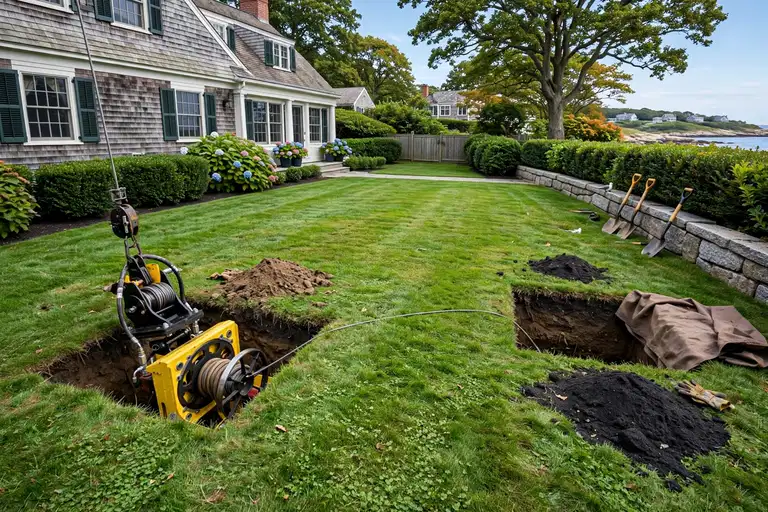
Minimal-Dig Sewer Repair for Nahant's Peninsula and Lowlands
Nahant is a one-square-mile peninsula with one land route — the Causeway — and a sewer system that funnels everything through a single critical node: the Lowlands Pump Station, which receives all town wastewater and pumps it through the Lynnway force main to Lynn's treatment plant. The town has already funded a major upgrade of that station plus gravity-sewer rehabilitation targeting inflow and infiltration — spot repairs, full liners, joint sealing and grouting, root treatment, and watertight manhole covers in low-lying areas. Private lateral work here happens inside a system under active rehabilitation, which means sloppy private-side repairs get noticed by the town faster than almost anywhere on the North Shore. Trenchless lateral renewal — sealed, jointless, watertight — is the private-side match for what the town is doing on its side of the connection.
The ground gives its own reasons. Nahant's rocky sections carry ledge at shallow depth, so open excavation hits rock fast; the Lowlands and waterfront properties sit low with high water tables and documented storm-driven wave overtopping that floods interior areas during major storms. A liner or burst renewal works from small pits in ledge country, seals out the tidal-influenced infiltration that the town's I&I program is fighting, and avoids the saturated-trench conditions that make open cuts slow and risky here. For the grand late-1800s summer homes with fieldstone foundations along Ocean Street, trenchless also means no excavation beside old masonry.
There is a coordination point worth naming: because Nahant's DPW is actively rehabilitating the collection system for infiltration, a homeowner's trenchless lateral project should be timed and documented with the town's program in mind — a sealed private lateral is exactly what the town wants connected to its renewed mains. Between the ledge, the Lowlands water table, the single-causeway access for heavy equipment, and the town-wide I&I effort, minimal-dig renewal is not just convenient in Nahant. It is the method that fits the peninsula.
Sealed Lateral Renewal for Nahant's Infiltration Fight
Nahant's sewer story is a town-wide infiltration battle, and private laterals are part of it. The municipality has funded a major Lowlands Pump Station upgrade plus gravity-sewer rehabilitation — full liners, joint sealing and grouting, root treatment, watertight manhole covers — all targeting inflow and infiltration. A homeowner's trenchless lateral renewal is the private-side mirror of that program: cured-in-place lining creates a jointless, watertight pipe inside the old lateral, sealing the same joints and root entries the town is sealing on its mains. When both sides are sealed, the system stops taking on water.
The peninsula's ground makes the method doubly appropriate. Rocky sections carry ledge at shallow depth, so open excavation hits rock fast; the Lowlands and waterfront properties sit low with high water tables and documented storm-wave overtopping that floods interior areas. Lining or bursting from small pits handles the ledge without drilling, seals out the tidal-influenced infiltration the town's program is fighting, and avoids the saturated-trench conditions that make open cuts slow here. For the grand late-1800s summer homes with fieldstone foundations along Ocean Street, trenchless also means no excavation beside old masonry.
There is a coordination dividend, too. Because Nahant's public works department is actively rehabilitating the collection system, a sealed private lateral is exactly what the town wants connected to its renewed mains — and sloppy private-side work gets flagged faster here than almost anywhere on the North Shore. Timing the lateral renewal with the town's program in mind, and documenting the sealed result, keeps the homeowner on the right side of that scrutiny. One square mile, one pump station, one causeway for heavy equipment: minimal-dig renewal is the method that fits the peninsula.
Trenchless Candidacy on the Nahant Peninsula
The system context is the first factor. Every drop of Nahant wastewater runs through the Lowlands Pump Station to Lynn's treatment plant, and the town is spending millions sealing its collection system against infiltration. A private lateral full of open joints undermines that investment; a trenchless-sealed lateral supports it. Candidacy here is partly civic: the sealed result is what the town's program assumes. The sealed private lateral is what the town's infiltration program assumes every connection will become.
The ground is the second. Shallow ledge on the rocky sections makes open excavation a rock job; low-lying Lowlands and waterfront lots bring high water tables and storm-driven wave overtopping that saturate any open cut. Trenchless renewal works from pits in ledge country and seals tidal-influenced infiltration from the inside — the two problems, solved by the one method. Ledge country and tidal infiltration are the two problems this one method solves together.
Access is the third. The Causeway is the single land route for heavy equipment, which makes compact trenchless rigs — small footprint, short duration — far more practical than an excavation operation. Add the fieldstone foundations of the 1870–1910 summer-home stock, which should never be excavated beside, and Nahant's candidacy is complete: sealed laterals, rock avoided, old masonry protected, one road in. One road in, one pump station, and a town watching infiltration: minimal-dig renewal fits the peninsula.
Our Trenchless Process in Nahant
Infiltration-focused camera survey
We film the lateral and quantify tidal-influenced infiltration at every joint — in Nahant, the water measurement leads, because sealing it is the point of the job. because sealing infiltration is the point of the job.
Program-aware renewal plan
The lining or bursting plan is drawn with the town's infiltration rehabilitation in mind, so the private lateral complements the renewed mains it connects to. so the private side matches the renewed mains.
Ledge-safe installation
Small pits and compact rigs renew the line inside its existing bore — no rock drilling, no excavation beside fieldstone foundations, no Causeway-blocking equipment. with no Causeway-blocking equipment staged.
Sealed and documented finish
A final camera pass verifies the watertight, jointless renewal, with documentation of the sealed result for the homeowner's records. documented for the homeowner's records.